Pelé: The Boy of 17 Who Won Three World Cups
Winning Score Team Published Sun 14 Jun Updated Sun 14 Jun
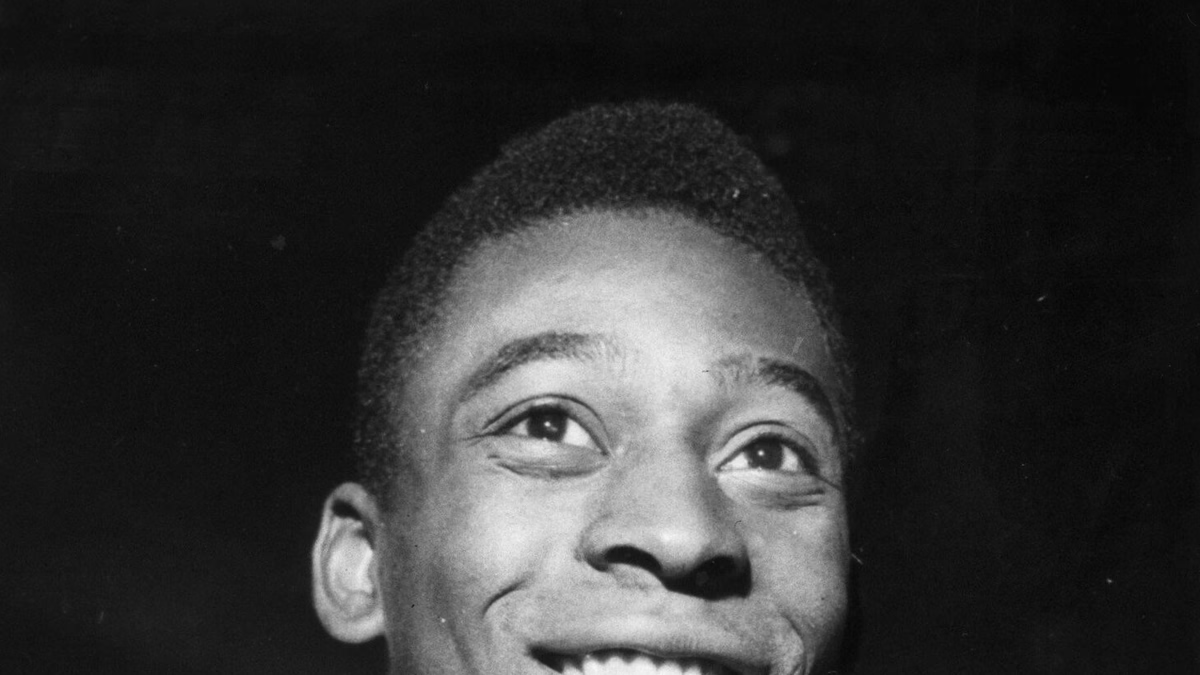
In Sweden, in 1958, a boy cried on the pitch after the final whistle.
He was 17.
And he had just become a world champion.
More than sixty years later, no human has matched what Pelé did — winning the World Cup three times. Not Maradona, not Messi, not anyone. Only Pelé. And it all began with that crying boy.
To see where Pelé stands among all the legends, read the 10 greatest World Cup players of all time.
The 20-second version
- The only player in history to win three World Cups — 1958, 1962, 1970
- In 1958, aged 17, he scored six goals including two in the final — the youngest scorer in a final ever
- In 1970 he had 4 goals + 6 assists (a single-tournament record) with a Brazil side many call the greatest ever
- World Cup totals: 4 tournaments, 14 games, 12 goals, 10 assists (an all-time record)
- His career goal tally is still disputed — from 757 to 1,283 depending on what you count
1958 — a legend born at 17
Pelé was born on 23 October 1940. When the 1958 World Cup kicked off he was just 17 years and 228 days old, and a knee injury kept him out of Brazil’s first two games.
But once he was on the pitch, the world was never the same.
- Quarter-final vs Wales — he scored the only goal of the game, becoming the youngest goalscorer in World Cup history
- Semi-final vs France (5–2) — a hat-trick, the youngest hat-trick scorer ever
- Final vs Sweden (5–2) — two goals, the first a flick over a defender and a volley that a stadium refused to believe came from a 17-year-old
In that final Pelé was 17 years and 249 days old — still the youngest scorer in a World Cup final in history. The FIFA Annual Report 2022 records that Pelé is “the youngest scorer, youngest hat-trick scorer, youngest finalist and youngest player to score in a final in World Cup history” (official FIFA document).
One small detail underlines just how young he was — Gunnar Gren, a Sweden player in that final, had made his international debut before Pelé was even born. That 20-year age gap between opponents in a final is the largest in World Cup history.
And when the final whistle blew, the boy sank to the pitch in tears and had to be held up by his teammates. The image of a 17-year-old who had just spellbound the world, then cried like an ordinary child — is one football has carried ever since. Real greatness so often begins in exactly that kind of human fragility.
1962 — a champion off the pitch
At the 1962 World Cup in Chile, Pelé arrived as, by common consent, the best player in the world.
Luck had other plans.
He played the opener against Mexico, scoring one goal after dribbling past four defenders and setting up another, before tearing a muscle in the second game against Czechoslovakia — and that was his tournament over, just 2 games and around 155 minutes.
Brazil still won their second title, beating Czechoslovakia 3–1 in the final, led by Garrincha, Vavá and Amarildo (Pelé’s replacement). Pelé collected a second winners’ medal without being on the pitch for the decisive stage — an often-forgotten chapter of his legend, but part of the three-title record no one can touch.
1966 — the tournament that nearly made him quit
Between the second medal and the third, there’s a dark chapter many forget.
The 1966 World Cup in England was Pelé’s worst. He was kicked relentlessly by opposing defenders, especially against Bulgaria and Portugal, in an era when the rules did far less to protect attacking players. Brazil went out in the group stage for the first time in years, and Pelé was so battered, in body and spirit, that he said he never wanted to play in a World Cup again.
Had the story ended there, Pelé would have been a prodigy who burned out early. Instead, four years later he came back to write the most perfect ending of all — and that’s what makes 1966 part of the story, not a blemish but the darkness before the dawn.

1970 — the peak of the beautiful game
If 1958 was the birth, 1970 in Mexico was where everything came together.
Pelé, now 29, was part of a Brazil side many rank as the greatest the World Cup has ever seen — a front five who were “all number 10s in their own right”: Jairzinho, Pelé, Gérson, Tostão and Rivellino.
His numbers that tournament say it all:
- 4 goals + 6 assists — those 6 assists in a single tournament are still an all-time record
- a hand in 14 of Brazil’s 19 goals
- Final vs Italy (4–1) — he headed Brazil’s opening goal and set up two more
Brazil 1970 scored over three goals a game, above the tournament average, and played football so beautiful it became the definition of “jogo bonito” — the beautiful game. At 29, Pelé no longer ran like the boy of 17, but he played with a reading of the game at its absolute peak — a complete master, closing the legend with a third title.
His header in the final is one of the images of the tournament — Pelé hanging in the air above the Italian defenders before nodding it into the far corner. And his pass for Carlos Alberto to thunder home Brazil’s fourth is rated one of the greatest team goals in World Cup history. That Brazil side didn’t just win — they won in a way that made the whole world fall in love with football.
Why three titles is the untouchable record
This is the number that defines Pelé better than any other — 3.
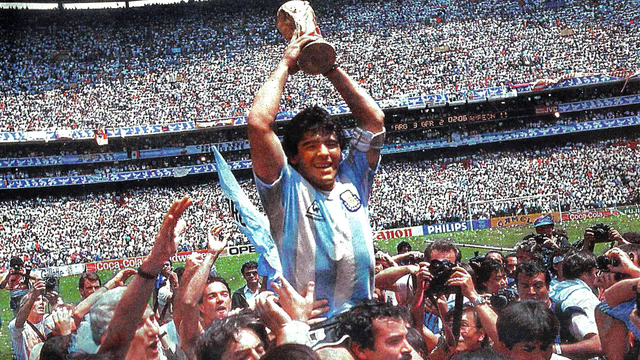
No player in history has ever held three World Cup winners’ medals. Guinness World Records states plainly that “in 1970, Pelé became the only footballer in history to lift the FIFA World Cup three times.” Great players like Maradona, Zidane, Ronaldo, Messi and Mbappé have all come close, but none managed it.
| Player | World Cup titles |
|---|---|
| Pelé | 3 (1958, 1962, 1970) |
| Maradona | 1 (1986) |
| Messi | 1 (2022) |
| Cristiano Ronaldo | 0 |
In an era where the World Cup gets harder every year, and no team has defended the title since Brazil in 1962, Pelé’s three-title record only looks safer with time.
And it isn’t the only record he left behind — Pelé is also one of only five players in history to score at four different World Cups (with Uwe Seeler, Klose, Cristiano Ronaldo and Messi), and he holds the record for most assists in finals — three (one in 1958 and two in 1970). Together these numbers paint a player who wasn’t great for a brief moment, but excellent across three decades of football.
Career goals — the figure no one agrees on
If there’s one question about Pelé that’s hardest to answer, it’s “how many goals did he score in his career?”
The answer depends on what you count — and that’s why there are so many figures:
| Source | Goals | Scope |
|---|---|---|
| FIFA (historical official figure) | 1,281 | Including friendlies / tours |
| Pelé himself | 1,283 | Including army games |
| RSSSF | 767 (competitive) / 1,284 (incl. unofficial) | Split by type |
| ESPN / mainstream statisticians | 757 | Club + country, competitive only |
The gap comes from Santos’s exhibition tours around the world through the 1950s and 60s, where Pelé scored prolifically. FIFA historically counted them; RSSSF and ESPN exclude them as non-competitive (comparison via Olympics.com). These days FIFA itself avoids a precise number, using “more than 1,200 goals” to acknowledge the dispute.
Every figure is right within its own scope — and however you count, Pelé remains one of the highest-scoring players in recorded football history.
A legacy still alive at the 2026 World Cup
In late 2000 in Rome, FIFA handed out a one-off “Player of the Century” award — jointly to Pelé and Maradona, after Pelé won the football-family vote (officials, coaches and magazine members) with 72.75%, while Maradona won the internet poll, so FIFA split the award following controversy over the online method. And when Pelé died on 29 December 2022, FIFA called him “immortal” — president Gianni Infantino said Pelé “took football to another level” — and named the pitch at its Zurich headquarters after him.
But the tangible legacy has a sad ending — under the old rules, any nation that won the World Cup three times kept the Jules Rimet Trophy permanently. Brazil earned that right in 1970 (as reported by AP in 1970). But the trophy was stolen from the Brazilian football federation’s offices in 1983 and never recovered — believed melted down. The one tangible object linking all three of Pelé’s triumphs no longer exists.
And at the 2026 World Cup now underway, Pelé’s name still has a stake — his record of 6 assists in one tournament and 10 across all finals is, beIN Sports notes, something Messi could close in on at this very tournament (beIN Sports). A legend who is gone still measures the ones who are still playing.
In the endless GOAT debate between Pelé, Maradona and Messi, there’s one measurable number nobody can argue with — three World Cup winners’ medals. Maradona has one, Messi one, Cristiano Ronaldo none. The Independent, in a 2026 World Cup preview, put it plainly: “No one else in football history has yet even come close to matching that” (The Independent). Whoever’s style you prefer, the number 3 still belongs to Pelé alone.
The boy who cried, who became the measure of the game
Pelé is gone, but the number 3 remains.
It isn’t just a statistic. It’s the story of a 17-year-old who cried in Sweden, grew through the pain of Chile, survived a night of brutal fouling in England that nearly made him quit, and returned to stand at the very top in Mexico as a complete master. Three tournaments, three decades of football, one man who did what no one has repeated.
At the 2026 World Cup now underway, there will always be a young star someone calls “the next Pelé.” But the number 3 still tells the same truth — no one has ever been the second Pelé at all.
Read about the legend at the other pole of the debate in Maradona 1986, or look back at the tournament’s hosts and history in the history of World Cup hosts.
Sources
- Pelé in memoriam — World Cup stats and records — FIFA Annual Report 2022 — FIFA, 2022
- Pelé, the only player to win three World Cups — Guinness World Records — Guinness World Records
- Pelé's World Cup numbers — ESPN — ESPN, 2022
- Pelé records that remain unbroken ahead of the 2026 World Cup — beIN Sports (8 Jun 2026) — beIN Sports, 2026
- The Pelé record Messi could break at the 2026 World Cup — beIN Sports (27 May 2026) — beIN Sports, 2026
- How many goals did Pelé score in his career — Olympics.com — Olympics.com, 2022
- Brazil keep the Jules Rimet Trophy after a third title (AP, 1970) — Fox News — Fox News / AP, 1970
- Pelé still tops the 50 greatest World Cup players list — The Independent (2026) — The Independent, 2026
FAQ
- How many World Cups did Pelé win?
- Three — 1958 (Sweden), 1962 (Chile) and 1970 (Mexico). He is the only player in history to do it, confirmed by Guinness World Records and FIFA. No other player has ever held three World Cup winners' medals.
- How old was Pelé when he won his first World Cup?
- 17, at the 1958 World Cup in Sweden. He scored six goals including two in the final, becoming the youngest scorer, youngest hat-trick scorer and youngest scorer in a final in World Cup history — records that still stand today.
- Why are there so many figures for Pelé's career goals?
- Because the scope differs. FIFA historically used 1,281 (including friendlies and tour games), while RSSSF and ESPN count only competitive matches at around 757–767. Pelé himself said 1,283. Each figure is right within its own scope and the source should always be stated.
- Which of Pelé's records could fall at the 2026 World Cup?
- His six assists in a single tournament (1970) and his all-time total of 10 — beIN Sports notes Messi could close in at 2026. His record as youngest scorer in a final is considered the safest, as no player younger is in the tournament.