Maradona 1986: The Man Who Carried a Team
Winning Score Team Published Sun 14 Jun Updated Sun 14 Jun
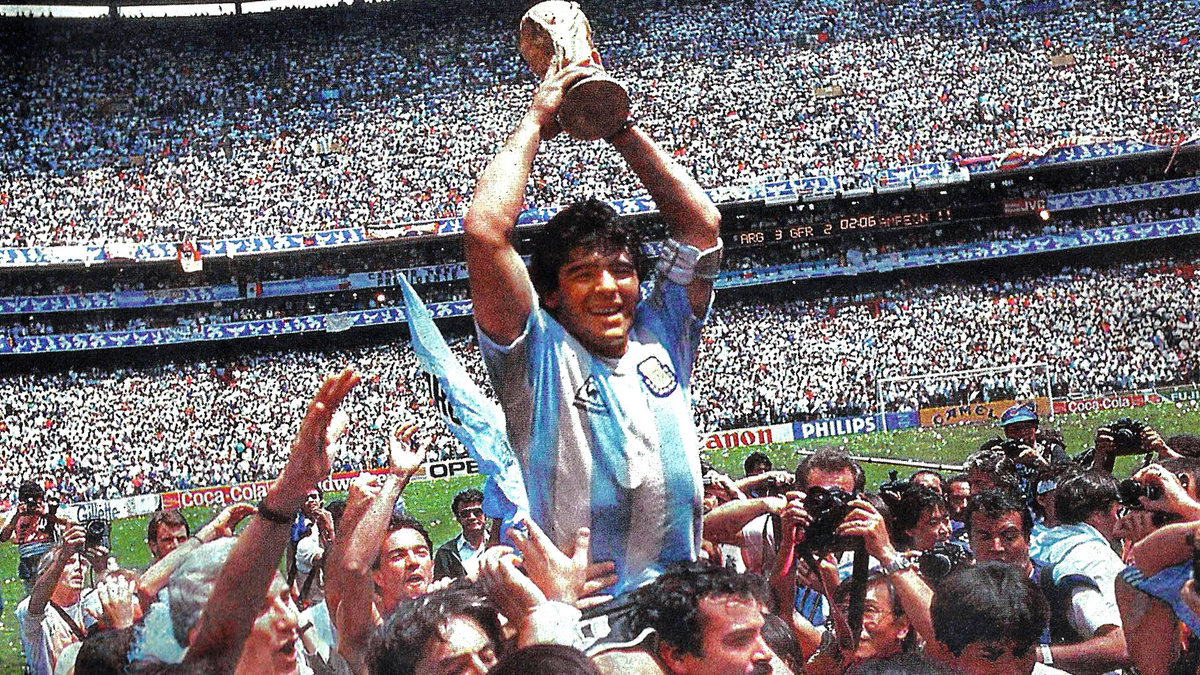
Everyone remembers 1986 as the year Argentina won the World Cup.
The numbers tell a different story.
Maradona was directly involved in 10 of Argentina’s 14 goals across the tournament — 71.4%, the highest share of any player at a World Cup since 1966. This wasn’t a team’s triumph. It was a tournament where one man carried a whole team to the top of the world.
Or… almost. Because behind that brilliance sat a system built specifically to set him free.
To see where Maradona stands among all the legends, read the 10 greatest World Cup players of all time.
The 20-second version
- 5 goals + 5 assists in 7 games = 71.4% of Argentina’s goals (assists are retrospective Opta data)
- In one game against England he scored both the Hand of God (the most infamous) and the Goal of the Century (the most beautiful)
- Won the Golden Ball in a landslide — 1,282 points to the runner-up’s 344
- Behind it all: Bilardo’s 3-5-2, designed to give Maradona freedom
- Today it anchors the GOAT debate alongside Messi’s 2022
The road to the title — step by step
Argentina went through the whole tournament unbeaten, drawing only once.
| Round | Opponent | Result | Venue |
|---|---|---|---|
| Group A | South Korea | 3–1 | Mexico City |
| Group A | Italy | 1–1 | Puebla |
| Group A | Bulgaria | 2–0 | Mexico City |
| Round of 16 | Uruguay | 1–0 | Puebla |
| Quarter-final | England | 2–1 | Azteca |
| Semi-final | Belgium | 2–0 | Azteca |
| Final | West Germany | 3–2 | Azteca |
In the final at the Azteca, in front of nearly 115,000 people, Argentina led West Germany 2-0 through José Luis Brown and Valdano before Rummenigge and Völler pulled it level at 2-2 late on — a game that looked to be slipping away. Then, in the 88th minute, Maradona threaded the pass that sent Burruchaga clear to score the winner. Even in a final where he was marked so tightly he didn’t score, he was still the decisive man. That was the whole tournament in one image — everything ran through him.
The four minutes that defined a legend
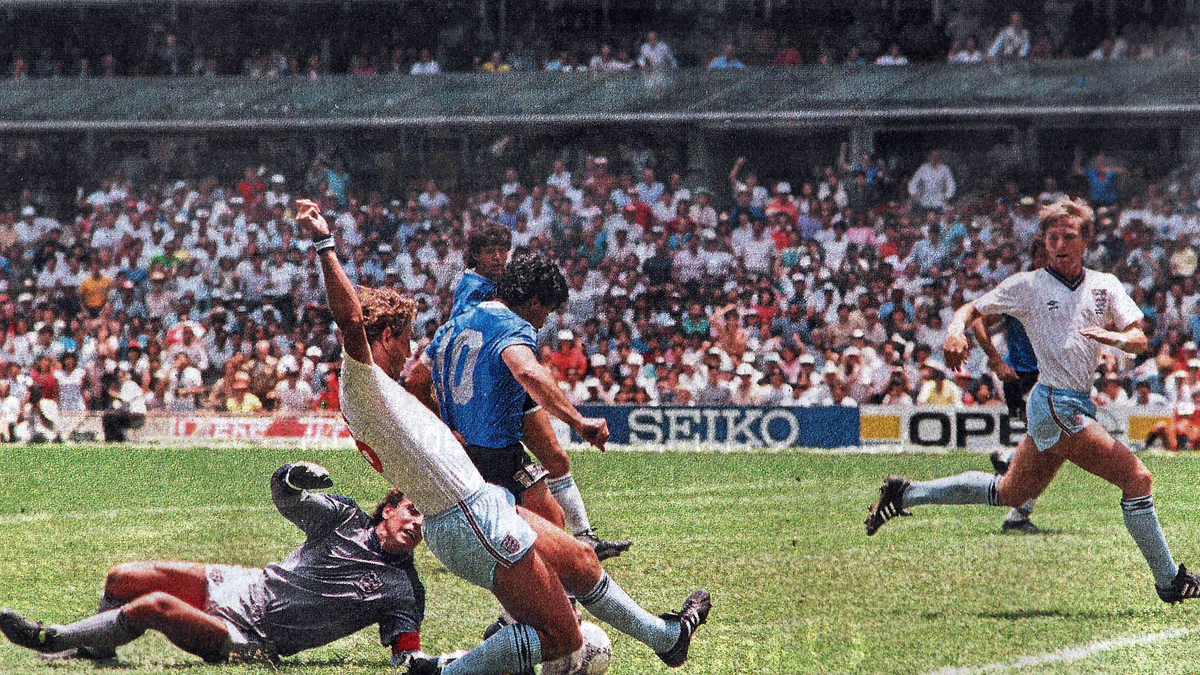
On 22 June 1986 at the Azteca, in front of around 115,000 people, in the quarter-final against England — within just four minutes, Maradona scored two goals at opposite ends of the moral spectrum.
51st minute — the “Hand of God”. A looping ball dropped into the box. Maradona, just 165cm tall, leapt with England keeper Peter Shilton and punched it into the net with his left hand. Referee Ali Bin Nasser didn’t see it and allowed the goal. Afterward Maradona delivered the immortal line — that it was scored “a little with the head of Maradona, and a little with the hand of God” (origin of the phrase via Britannica). That November he admitted to the British press: “It was me. It was not the hand of God.”
56th minute — the “Goal of the Century”. Just four minutes later, Maradona collected the ball in his own half and dribbled through half the pitch, past five England players and the goalkeeper, before finishing. FIFA puts the run at about 11 seconds, some sources at 10.6; the distance ranges from roughly 55 to 68 metres depending on the source — the figures differ because they measure from different starting points, and no official 1986 document records them. What every source agrees on is that it is the greatest solo goal the World Cup has ever seen. In 2002 fans voted it the official Goal of the Century.
Even the details are still debated — some sources count 11 touches and six opponents beaten (counting Terry Butcher, beaten twice), while most count five outfield players plus the goalkeeper. That small difference shows that even a goal replayed a million times has no single official set of numbers everyone agrees on.
The most infamous goal and the most beautiful goal in history, in the same game, four minutes apart, from the hand and the feet of the same man.
The shadow of a war behind it
For Argentine fans, the England game wasn’t only football — it came just four years after the Malvinas (Falklands) War, which Argentina lost to Britain.
But that political framing has to be told carefully, and only in the words of those who actually spoke them. Maradona himself is the clearest source — in his 2004 autobiography he wrote: “Before the match we said football had nothing to do with the Malvinas war. But we knew a lot of Argentine kids died… This was revenge” (reported by The Independent).
Tim Vickery, the BBC and World Soccer South America correspondent, sees the feeling as running deeper than the war itself — a nation once on the weaker end of British influence “acting out a profound national fantasy” through a single game. But the record must be complete: Maradona also said, in 2016, “I do not confuse sport with politics, still less a war that brought us so much pain.” The “revenge” framing is his own interpretation, not settled history.
The numbers behind the greatness — with the caveat that’s required
Statistically, Maradona’s 1986 has almost no equal (data via ESPN/Opta):
- 5 goals + 5 assists in 7 games = 10 goal involvements, the only player to do that in one tournament since 1966
- 53 completed dribbles — the most in World Cup history since 1966
- 53 fouls drawn — also the most ever, a sign opponents couldn’t stop him by fair means
- Golden Ball in a landslide — 1,282 points, with the runner-up (Schumacher) on just 344
But to be precise — FIFA did not officially track assists in 1986. The five-assist figure comes from later Opta/Stats Perform analysis, not from official documents of the era. It is credible, but its source must be stated; it is not an official FIFA statistic.
His Golden Ball award has a story of its own — the physical trophy, presented at a ceremony in Paris in 1986, vanished for decades before resurfacing at a private Paris auction in 2016 and going up for sale again in 2024 — much like its owner, a story that never ends quietly.
”One man” or “one man plus a system”
This is where the popular story usually slips.
Maradona didn’t float above a weak team — he played in a system built specifically for him. Argentina coach Carlos Bilardo designed a 3-5-2 that deliberately added a midfielder to give Maradona space and freedom, and held it back until the England game. Bilardo put his reasoning plainly: “You can’t play against the English with a pure centre-forward. They’d devour him, and the extra man in midfield will give Maradona more room” (analysis by Jonathan Wilson, World Soccer).
Jorge Valdano, the teammate who scored four goals that tournament, put it best — “The team was based on a very solid architecture. In the midst, a genius granted the privilege of freedom… but the team was very structured tactically, and each of us had very precise obligations.”
That truth makes the story richer, not smaller — Maradona’s genius was real, but it was engineered to flourish. The true greatness is a single man good enough to make an entire system revolve around him.
Even Jonathan Wilson, the tactics writer who first highlighted the system, concedes that “the suggestion Maradona won that World Cup almost single-handedly isn’t entirely untrue” — he was only able to do it because of a structure that supported him, both defensively behind and with passing options ahead.
What the world said about 1986
The words of those who were there say more than the stats.
Tim Vickery wrote in World Soccer that “what Maradona did brooked no comparison. He took on sub-standard pitches and brutal defending to give an exhibition of the game so complete that whenever great players met, they were in awe of him. He was the idol of the idols.”
More telling is the view from the other side — Bobby Moore, the England legend, said on the eve of the 1986 final: “What impresses me is that he has a profound knowledge of what is required of him. He doesn’t get carried away with the idea of trying to do it all on his own” — praise from an opponent who saw past the one-man-show image to the intelligence of his team play.
1986 in today’s GOAT debate
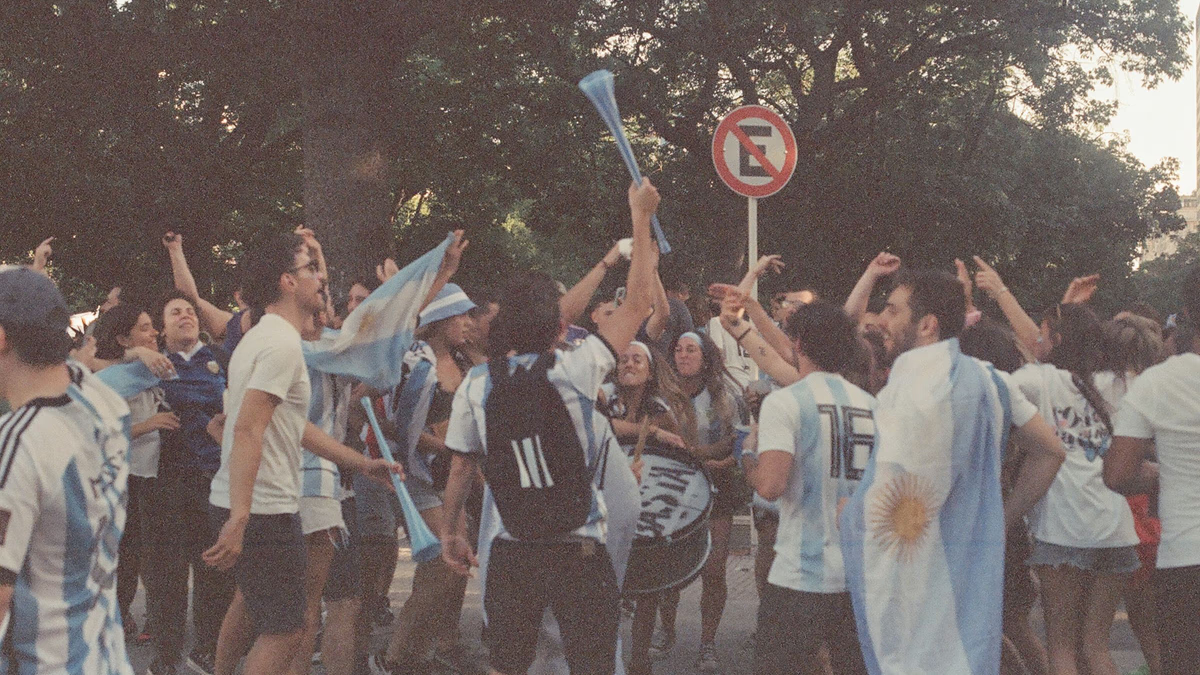
Nearly forty years on, the 1986 World Cup is still the anchor in the argument over the greatest player of all time.
Maradona’s camp uses 1986 as the centrepiece — one tournament won almost single-handedly, at a level no one has reached since. Fabio Cannavaro, the 2006 World Cup winner, still insists: “Messi is top, but Maradona is another world… He’s not one of the best, he’s the best.”
The other side points to longevity — Gary Lineker, who was on the pitch that day as an England player, said after Messi’s 2022 title: “I never thought I’d see a better player than Maradona… but I think Messi’s done it through what he’s achieved now and his longevity” (The Independent).
Even Lionel Scaloni, the coach who led Argentina to the 2022 title, picks Messi in the debate — but says plainly: “If I have to stay with one, I’ll stay with Leo, with whom I have something special” — an answer that admits there is no comparison of these two legends that satisfies everyone.
Both sides use 1986 as their reference point — and that, in itself, proves how vast what Maradona did in Mexico really was. It became a yardstick that even the new GOAT still has to be measured against.
The night that became a measuring stick
Maradona passed away in 2020, but those seven games in Mexico in 1986 have never faded.
It wasn’t perfect — there was a hand that shouldn’t have counted, a political framing still argued over, and a Bilardo system too often forgotten. But maybe that’s exactly what makes it human and a legend at the same time.
At the 2026 World Cup, plenty of players will try to write a night the world remembers. But however well any of them does it, the measuring stick is still the same name — seven games from a small man out of Buenos Aires who dragged a whole country to the top of the world in the summer of 1986.
Read about the Brazilian legend at the other pole of the debate in Pelé, the boy of 17 who won the World Cup, or see the full picture in the 10 greatest World Cup players of all time.
Sources
- Full 1986 World Cup results and stats — RSSSF — RSSSF
- Maradona's genius measured in numbers — ESPN (25 Nov 2020) — ESPN / Opta, 2020
- The origin of the Hand of God phrase — Britannica — Britannica
- The Goal of the Century, an 11-second dash — FIFA — FIFA, 2011
- Maradona admits the handball, 1986 — Los Angeles Times (17 Nov 1986) — Los Angeles Times, 1986
- Maradona on the Malvinas/Falklands framing, 2004 — The Independent — The Independent, 2004
- Bilardo's 3-5-2 that freed Maradona — World Soccer (Jonathan Wilson) — World Soccer / Jonathan Wilson
- Lineker says Messi has surpassed Maradona — The Independent (17 Dec 2022) — The Independent, 2022
FAQ
- How many goals did Maradona score at the 1986 World Cup?
- Five goals in seven matches, including the Hand of God and the Goal of the Century in the same game against England. Retrospective Opta/Stats Perform data also credits him with five assists, for 10 of Argentina's 14 goals, or 71.4%.
- Why must Maradona's five assists be labelled 'retrospective'?
- Because FIFA did not officially track assists in 1986. The five-assist figure comes from later analysis by Opta/Stats Perform, not from official 1986 FIFA match documents, so the source should always be stated clearly.
- How long and how far was the Goal of the Century?
- Sources vary slightly — FIFA and Britannica say about 11 seconds, some say 10.6; the distance ranges from roughly 55 metres (60 yards) to 68 metres. He beat five England outfield players plus the goalkeeper. No official 1986 document records an exact figure.
- Maradona 1986 or Messi 2022 — who was greater?
- It's the anchor of the GOAT debate. Maradona's case rests on one tournament won almost single-handedly; Messi's on sustained excellence and finally winning in 2022. Gary Lineker, on the pitch in 1986, believes Messi has surpassed him on longevity, while Cannavaro still rates Maradona first.