4 Debutant Nations the 48-Team World Cup Let In
Winning Score Team Published Sun 14 Jun Updated Sun 14 Jun
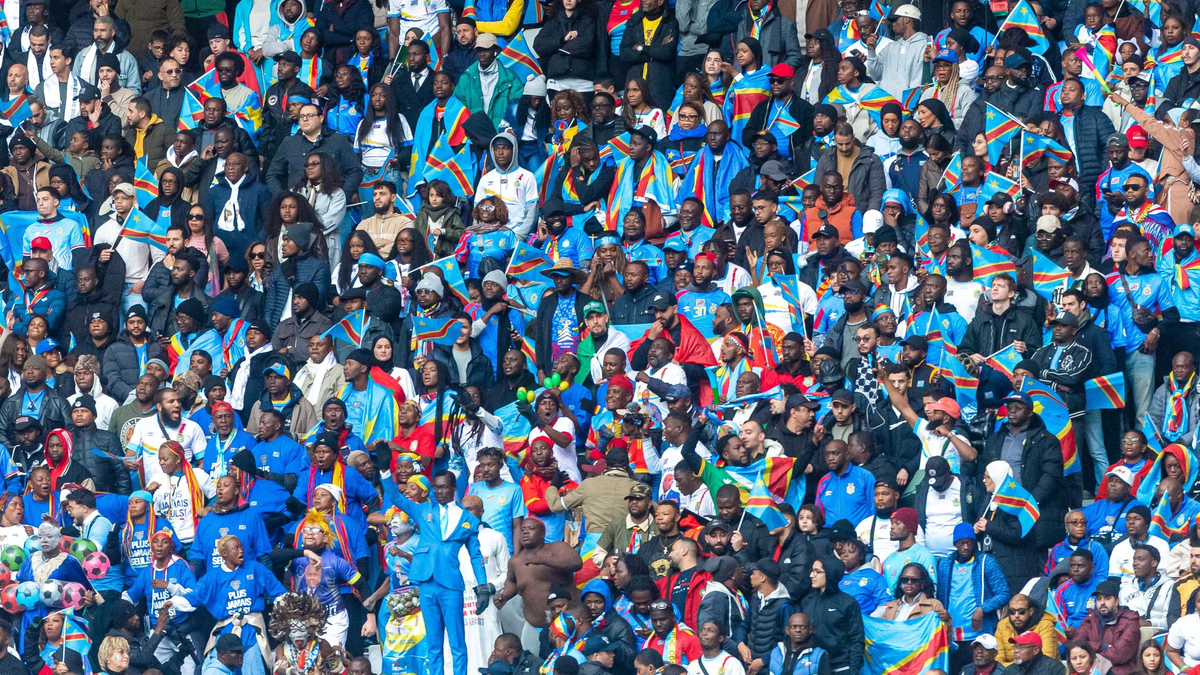
The expansion to 48 teams has been criticised for bloating the tournament.
But look at it another way.
Forty-eight teams didn’t just add more matches — it opened the World Cup, for the first time in history, to four nations that had waited a lifetime for this. Cape Verde, Curaçao, Jordan and Uzbekistan. Each has its own story, and each has a structural reason behind it.
For the bigger picture of why small nations keep closing on the giants, read are minnows toppling giants more often — this piece is about the four first-timers specifically.
The 20-second version
- Four debutants: Cape Verde (CAF), Curaçao (CONCACAF), Jordan + Uzbekistan (AFC)
- The key is the 48-team slot maths — every confederation gained places: AFC 4.5→8, CAF 5→9, CONCACAF 3.5→6
- Uzbekistan are the highest-ranked of the group (50th), Curaçao the lowest (82nd) — as of 11 June 2026
- Populations span the extremes: Uzbekistan 37.5 million vs Curaçao 158,000
- 4 of 48 teams (8.3%) — roughly in line with the old 32-team average, not the flood it feels like
The four debutants — who’s who
| Nation | Confederation | Group | FIFA rank | Population | Star |
|---|---|---|---|---|---|
| Uzbekistan | AFC | K | 50 | 37.5m | Shomurodov |
| Jordan | AFC | J | 63 | 11.5m | Al-Tamari |
| Cape Verde | CAF | H | 67 | 525,000 | Ryan Mendes |
| Curaçao | CONCACAF | E | 82 | 158,000 | Tahith Chong |
(Official FIFA rankings as of 11 June 2026)
The numbers tell a striking story — these four share almost nothing, from continent to population to footballing style. They have exactly one thing in common: none had ever appeared at a World Cup finals before.
The population gap is the starkest part. Uzbekistan’s 37.5 million is nearly 240 times Curaçao’s 158,000 — and both stand on the same stage. That is what sets the World Cup apart from any other event: a tiny island and a large nation play to the very same rules, and on a good enough day, the size of a country isn’t the answer.
Profiles and the roads that got them here
Uzbekistan — the highest-ranked debutant in this group. They finished second in their Asian third-round group behind Iran to qualify directly, losing only once in 15 qualifiers. They are coached by Fabio Cannavaro, the 2006 World Cup winner and Ballon d’Or holder (appointment reported by Reuters), and led by Shomurodov, their all-time top scorer (43 goals), and Khusanov, a Manchester City centre-back.
Jordan — “Al-Nashama” finished as group runners-up in Asia’s third round, sealing their ticket on 5 June 2025 with a 3-0 win away to Oman (an Ali Olwan hat-trick) (Reuters report). This was Jordan’s seventh attempt, after coming agonisingly close in a 2013 playoff against Uruguay. Their star is Mousa Al-Tamari, the captain at Stade Rennais and the first Jordanian to play in Ligue 1.
Cape Verde — an African island nation of just 525,000 people, they won African qualifying Group D outright on 23 points, four clear of Cameroon (eight previous World Cups), without conceding in five home games. Captain Ryan Mendes is their all-time top scorer and most-capped player, with a shot at reaching 100 caps during the tournament.
Curaçao — the smallest nation in World Cup history (158,000 people), who topped CONCACAF’s final-round Group B unbeaten on 12 points, coached by 78-year-old Dick Advocaat. The island’s full story is in Curaçao: the smallest nation in World Cup history.

Why 48 teams opened the door for them
Good players alone aren’t enough — what really changed the game was the slot maths.
When the FIFA Council voted unanimously in January 2017 to expand the World Cup to 48 teams (official FIFA release), every confederation gained places. Compare 2022 to 2026:
| Confederation | 2022 slots | 2026 slots | Change |
|---|---|---|---|
| Europe (UEFA) | 13 | 16 | +3 |
| Africa (CAF) | 5 | 9 | +4 |
| Asia (AFC) | 4.5 | 8 | +3.5 |
| North America (CONCACAF) | 3.5 | 6 | +2.5 |
| South America (CONMEBOL) | 4.5 | 6 | +1.5 |
| Oceania (OFC) | 0.5 | 1 | +0.5 |
That difference is the whole story. Under the old quotas, group runners-up like Uzbekistan and Jordan would have faced an intercontinental playoff. With 8 AFC slots, both group winners and strong runners-up qualify directly. Cape Verde the same — CAF’s rise to 9 let every first-round group winner go through. And Curaçao took one of CONCACAF’s three direct berths (alongside Panama and Haiti) that open up once the three host nations are removed from the count.
In fairness, not every one of them survived on the slot maths alone. Fox Sports noted Uzbekistan’s qualifying tally was strong enough — 21 points from 10 third-round games — that they would likely have made it even under the old 32-team format. Cape Verde, for their part, beat a Cameroon side with eight previous World Cups. The extra slots didn’t hand out free tickets; they simply lowered the final hurdle, so teams that had already proven themselves on the pitch no longer had to gamble everything on a single playoff.
To understand the group and knockout mechanics in full, read how the 48-team World Cup format works.
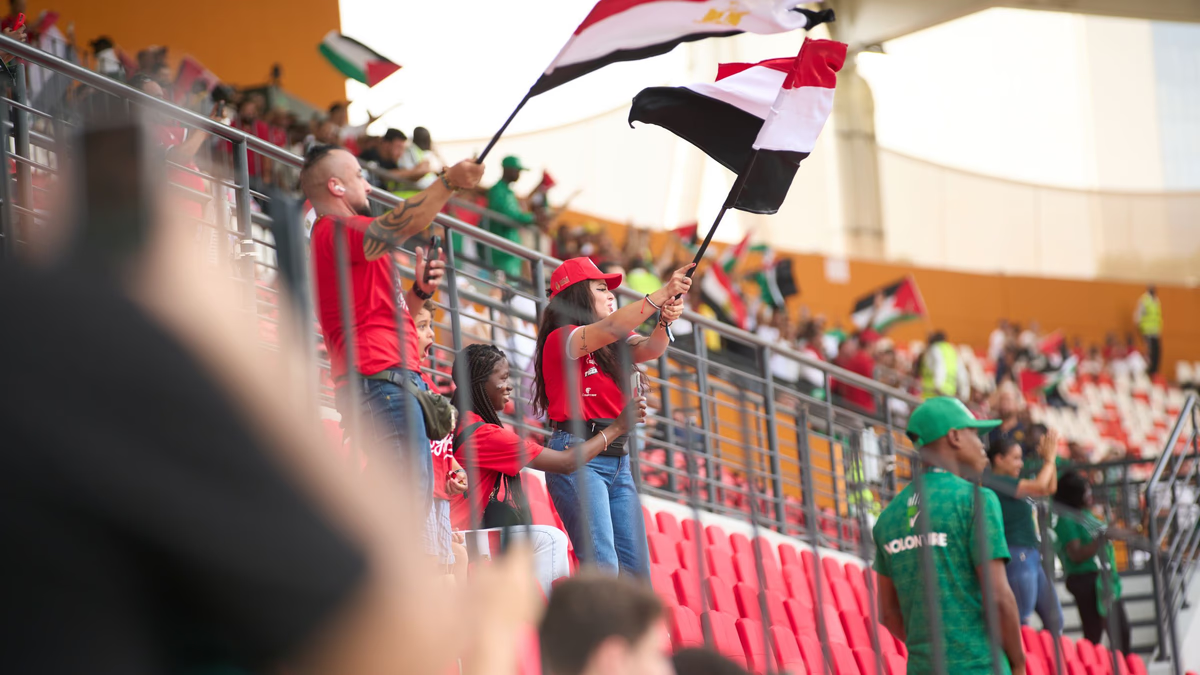
But are there really “more first-timers”? Check the history
This is where the data flips the feeling.
| Year | Teams | Debutants | First-time nations |
|---|---|---|---|
| 1998 | 32 | 4 | Croatia, Jamaica, Japan, South Africa |
| 2002 | 32 | 4 | China, Ecuador, Senegal, Slovenia |
| 2006 | 32 | 6 | Angola, Ghana, Ivory Coast, Togo, Trinidad & Tobago, Ukraine |
| 2010 | 32 | 0–2 | Serbia, Slovakia (strict definition) |
| 2014 | 32 | 1 | Bosnia and Herzegovina |
| 2018 | 32 | 2 | Iceland, Panama |
| 2022 | 32 | 1 | Qatar (host) |
| 2026 | 48 | 4 | Cape Verde, Curaçao, Jordan, Uzbekistan |
Across the 32-team era (1998–2022, seven tournaments) there were 20 debutants in total — about 2.86 per tournament, or roughly 8.9% of participants. In 2026 it’s 4 of 48, or ~8.3%.
In other words, the crop of first-timers this year is not unusually large — the proportion is close to the old average. Expansion added 50% more slots, yet the share of debutants barely moved. (Note: this proportion is a Winning Score calculation from the table above, not a directly published statistic.)
In fact the most debutant-heavy edition of the 32-team era was 2006, with six first-timers — more than 2026, and from a smaller field. The lesson is that the number of newcomers tracks where football is rising in a given region, not the size of the tournament alone. This year simply happens to coincide with Asia, Africa and the Caribbean all producing ready sides at once.
The unfinished debate — access or dilution

There are two sides here that deserve to sit next to each other.
For — Arsène Wenger, FIFA’s chief of global football development, calls it “a natural evolution,” pointing out that even at 48 teams, fewer than 25% of FIFA’s 211 members are there — three-quarters of the world still isn’t. Giving nations that never had a chance something to chase, he argues, is the most powerful tool there is for spreading the game.
Against — author Jonathan Wilson warns of “the dilution of the spectacle,” arguing every World Cup match should feel essential. Former US international Clint Dempsey put it bluntly: it can feel as though the tournament “doesn’t truly begin until the round of 32.”
The dissent isn’t only from analysts — Oliver Bierhoff, the former Germany team manager, said back at the announcement that 48 teams “feels like it’s too much,” while England’s PFA has raised player-welfare concerns about the extra match load.
But the commercial numbers are too big to wave away. FIFA projects six billion engagements across TV, streaming and digital for 2026, and tournament revenue in the region of nine billion dollars and up — driven largely by the extra matches and the North American market. Expansion, then, is both a mission to spread the game and a revenue engine at the same time.
Both have a point, and the data doesn’t clearly back either. What can’t be argued away is this: the night Jordan beat Oman, the night Cape Verde edged past Cameroon, the night Curaçao drew in Jamaica — for the people on those islands and in those countries, it was the biggest night in their nation’s history.
Nations that were never there are about to have a place
The four first-timers will be underdogs in almost every match, and no one expects them to go far.
But that misses the point.
The point is a child in Praia seeing Cape Verde’s flag at a World Cup for the first time, a fan in Tashkent who waited 34 years, and a whole island in Curaçao that never dared dream of this. Expansion may be argued about forever — but for them, the door that just opened is everything.
Keep the World Cup 2026 groups page open and watch how these newcomers write the next chapter, or explore every side at World Cup teams.
Sources
- Official World Cup 2026 team list — FIFA — FIFA, 2026
- Jordan qualify for the World Cup for the first time — Reuters (5 Jun 2025) — Reuters, 2025
- Cannavaro to coach Uzbekistan at debut World Cup — Reuters (6 Oct 2025) — Reuters, 2025
- Cape Verde become second-smallest nation to reach a World Cup — BBC Sport — BBC Sport, 2025
- Curaçao become smallest-ever nation to qualify — ESPN — ESPN, 2025
- FIFA Council unanimously expands the World Cup to 48 teams from 2026 — Inside FIFA — FIFA, 2017
- Slot allocation for the 48-team World Cup — Inside FIFA — FIFA, 2017
- The allocation of additional World Cup slots (peer-reviewed) — SAGE Journals — Journal of Sports Analytics / SAGE, 2023
FAQ
- How many debutant nations are at World Cup 2026?
- Four nations reach a World Cup finals for the first time in their history: Cape Verde (CAF), Curaçao (CONCACAF), Jordan and Uzbekistan (both AFC), confirmed by FIFA's official team list.
- Why does World Cup 2026 have so many first-timers?
- Because the tournament expanded from 32 to 48 teams, every confederation gained slots — AFC from 4.5 to 8, CAF from 5 to 9, CONCACAF from 3.5 to 6 — letting group winners and strong runners-up qualify directly without an intercontinental playoff.
- How did Uzbekistan and Jordan qualify?
- Both finished second in their AFC third-round groups to qualify directly. Uzbekistan lost only once in 15 qualifiers; Jordan sealed it by beating Oman 3-0 on 5 June 2025.
- Who are the star players among the debutants?
- Uzbekistan have Shomurodov (their all-time top scorer) and Khusanov (Manchester City); Jordan have Al-Tamari (Rennes, Ligue 1); Cape Verde have captain Ryan Mendes; Curaçao have Tahith Chong (Sheffield United).