10 Greatest World Cup Players of All Time
Winning Score Team Published Sun 14 Jun Updated Sun 14 Jun

Johan Cruyff never won the World Cup.
Not once.
Yet almost every list of the greatest World Cup players of all time has his name on it — and that is the key that unlocks this whole piece. Greatness at a World Cup isn’t always measured in trophies. It’s measured in the moments that made the world stop and watch together.
These are the ten names that come up most often when the world argues about who was the best — with the reasons why ranking them is harder than anyone expects.
To see who is leading the race for the Golden Boot this time, read the World Cup 2026 Golden Boot race.
The 20-second version
- Pelé tops almost every list — the only player in history to win three World Cups
- Cruyff is the only one of these ten who never won, yet remains a legend
- Klose is the all-time top scorer (16 goals); Müller has the best rate (1.08 per game)
- Maradona 1986 is the greatest single-tournament performance (5 goals + 5 assists)
- Messi 2022 filled the last gap and reset the GOAT debate entirely
The ten legends — and the numbers behind them
| Player | Nation | World Cups | Titles | Goals | Signature |
|---|---|---|---|---|---|
| Pelé | Brazil | 4 | 3 | 12 | Only three-time winner in history |
| Maradona | Argentina | 4 | 1 | 8 | The one-man show of 1986 |
| Messi | Argentina | 5 (+2026) | 1 | 13 | Record 26 World Cup appearances |
| Cruyff | Netherlands | 1 | 0 | 3 | Defined Total Football in 1974 |
| Beckenbauer | West Germany | 3 | 1 | 5 | Reinvented the libero role |
| Zidane | France | 3 | 1 | 5 | Two headers in the 1998 final |
| Ronaldo (R9) | Brazil | 4 | 2 | 15 | Once held the all-time scoring record |
| Garrincha | Brazil | 3 | 2 | 5 | Golden Ball + Boot + title in 1962 |
| Gerd Müller | West Germany | 2 | 1 | 14 | 10 goals in a single tournament (1970) |
| Mbappé | France | 2 (+2026) | 1 | 12 | Hat-trick in the 2022 final |
(Stats through the 2022 World Cup; Messi’s and Mbappé’s 2026 figures are provisional and must be verified after matches.)
The table dispels a myth straight away — nine of these ten won a World Cup. Only Cruyff never did. So the line that “half of these legends never won” simply isn’t true for this group. What is true is deeper: the trophy is not the only measure.
Three kinds of greatness
Sort these legends by the kind of greatness they carry, and it becomes clear why you can’t compare them head-to-head.
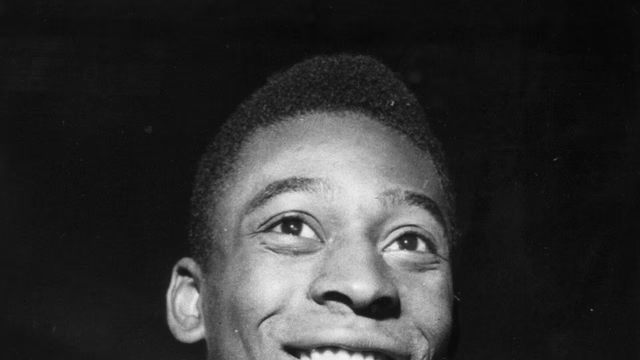
Kind one — the king of consistency (Pelé). The only player to win three World Cups (1958, 1962, 1970), confirmed by Guinness World Records as the only man in history to do it. Pelé scored 12 goals in 14 games, and in 1970 he produced 6 assists in a single tournament — a record still unbroken.
The story began in Sweden in 1958, when Pelé was just 17 — he scored in the semi-final and twice more in the final, becoming the youngest player ever to score in a World Cup final. In 1962 he was injured in the opening game; in 1966 he was kicked out of the tournament by brutal defending as Brazil went out, and he nearly walked away from the World Cup for good. Instead he returned in 1970 with a Brazil side many rank as the greatest of all time, finishing with a third title at 29 — a journey with every high and low, not just a tidy set of numbers.
Kind two — the gods of a single tournament. Some weren’t great by accumulation but by one tournament where everything exploded at once:
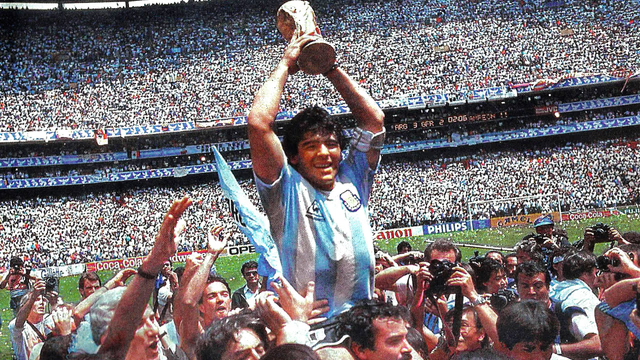
- Maradona 1986 — 5 goals + 5 assists in 7 games, 10 goal involvements, the only player to do that in one tournament since 1966 (stats confirmed by ESPN). The full story is in Maradona 1986.
- Gerd Müller 1970 — 10 goals in 6 games, the last man to score 10 in a single World Cup, at a career rate of 1.08 goals per game, the best of anyone with 10-plus.
- Garrincha 1962 — won the Golden Ball, the Golden Boot and the title in the same tournament. Brazil never lost a World Cup match with both Pelé and Garrincha on the pitch.
Kind three — the men who changed the game. Some names changed how the world plays football — Cruyff and the Total Football of 1974, where 8 of the Netherlands’ 14 goals ran through him, and Beckenbauer, who reinvented the libero, turning an ordinary defender into the start of every attack. Beckenbauer is one of only a handful of men to win the World Cup as both a player (1974) and a coach (1990). Neither is measured by goals, but by influence that still shapes the game today.
The modern legends who defined a decade each
The last three names on the list tell the story of football in an era when every moment is filmed and every stat is tracked.
Ronaldo “R9” — the Brazilian phenomenon who once held the all-time World Cup scoring record with 15 goals. He scored 8 in 2002 to drive Brazil to the title and take the Golden Boot. Remarkably, he held a winners’ medal from 1994 without playing a single minute, then broke down in the 1998 final before reclaiming everything in 2002.
Zidane — the brain of France’s golden era, who headed twice past Brazil in the 1998 final to win the hosts their first World Cup, and took the Golden Ball in 2006 even as he ended his career with a red card for headbutting Materazzi in the final — an image that became a symbol of both genius and human fragility.
Mbappé — the fastest heir of all, a champion at 19 in 2018 who then scored a hat-trick in the 2022 final, something not seen since 1966. With 12 goals from just two tournaments he has already drawn level with Pelé’s 12 across four — and he has years still ahead of him.
Why ranking them is genuinely hard
The problem isn’t “who was good.” It’s “measured by what” — and each criterion gives a different answer.
| Criterion | Who it favours | Who it penalises |
|---|---|---|
| Trophies won | Pelé (3) | Cruyff (0) |
| Single-tournament impact | Maradona 1986, Müller 1970 | Steady but never peaked |
| Sustained excellence | Messi (5 WCs), Pelé (4) | Cruyff (1 WC) |
| Era-adjusted | Modern players with full data | Pelé/Garrincha (no assist data pre-1966) |
That’s why different outlets reach different orders — ESPN’s 2014 list put Cruyff at No. 3 (above World Cup winner Müller) by weighting individual brilliance, while The Independent’s 2026 panel of 14 journalists voted Pelé first on 690 points, Maradona on 593 and Messi on 543. Al Jazeera likewise placed Pelé and Maradona at the top.
And one more name deserves an honest mention — Miroslav Klose, the all-time World Cup top scorer with 16 goals, who passed Ronaldo in 2014. Several 2026 lists put him in the top 10. That the highest scorer in history is treated as the “11th choice” tells you everything about how complicated the criteria for greatness really are.
The records that endure across decades
Behind the ranking arguments sits a set of numbers that stays fixed across the eras:
- All-time top scorers: Klose 16 → Ronaldo 15 → Gerd Müller and Fontaine on 13
- Most goals in one tournament: Just Fontaine, 13 in 1958 — a record that has stood for 68 years with no sign of falling, ahead of Kocsis (11, 1954) and Müller (10, 1970)
- Most appearances: Messi, 26, passing Matthäus (25)
- Most assists in one tournament: Pelé, 6 in 1970
- Multiple Golden Balls: Messi alone has two (2014, 2022)
What the stat sheet captures, and the ranking lists can’t, is that some greatness is measurable — and some, like the night Maradona dragged a whole team to the title, or the way Cruyff redefined the entire system, has no column to fit into.
Messi 2022 and the GOAT shift
Before December 2022, the GOAT debate had one hole everyone could point to — Messi had no World Cup.
Then the night in Lusail changed everything.
Argentina beat France in a final many call the greatest in history, and Messi took the Golden Ball — becoming the first player to win it twice (2014 and 2022). On the record sheet, Messi has played 26 World Cup games, the most ever, passing Lothar Matthäus, with 21 goal involvements (13 goals + 8 assists) — the most by any man since 1966, level with Pelé (stats from Olympics.com).
That trophy didn’t end the argument, but it erased the last objection the other side had, and it lifted Messi onto the same line as Pelé and Maradona on many lists.
Tellingly, the debate replays the old clash of criteria — the “one perfect night” camp points to Maradona 1986, while the “sustained excellence” camp points to Messi across five tournaments. Both ESPN in 2014 and The Independent’s 2026 panel chose Pelé at No. 1, citing his trophy count as decisive — yet both admit there is no answer everyone agrees on.
Greatness has no single formula
If there’s one lesson in these ten names, it’s this — no single yardstick settles it.
Pelé has the most trophies. Maradona has the most perfect single night. Klose has the most goals. Müller has the most ruthless rate. And Cruyff — with no trophy at all — has an influence that changed the game forever. Every one of them is the right answer, depending on the question you ask.
And that is the magic of the World Cup — it doesn’t just produce champions, it produces a different kind of legend in every era, the ones each generation keeps arguing over. The 2026 tournament is about to add a new name to that conversation — the only question is who will write the night the world remembers for decades.
Read the deep profiles of the two legends argued about most in Maradona 1986 and Pelé, the boy of 17 who won the World Cup, or look back at the tournament’s hosts and history in the history of World Cup hosts.
Sources
- The 50 greatest World Cup players (14-journalist panel) — The Independent — The Independent, 2026
- The 10 best FIFA World Cup players of all time — Al Jazeera — Al Jazeera, 2026
- Pelé, the only player to win three World Cups — Guinness World Records — Guinness World Records
- Pelé's World Cup numbers — ESPN — ESPN, 2022
- Maradona's genius measured in numbers — ESPN — ESPN, 2020
- Lionel Messi's World Cup stats and records — Olympics.com — Olympics.com, 2026
- The legend of Gerd Müller in numbers — ESPN — ESPN, 2021
- Official Golden Ball winners — FIFA+ — FIFA+
FAQ
- Who is the greatest World Cup player of all time?
- Most lists place Pelé first, as the only player to win three World Cups (1958, 1962, 1970), followed by Maradona and Messi. The Independent's 2026 panel of 14 journalists also ranked Pelé first, on 690 points.
- Which legend never won the World Cup?
- Johan Cruyff. Of these ten legends he is the only one who never lifted the trophy, finishing runner-up in 1974, yet he is still ranked among the greatest of all time — proof that greatness is not measured by trophies alone.
- Who is the all-time top scorer at the World Cup?
- Miroslav Klose of Germany, with 16 goals, passing Ronaldo's 15 in 2014. Gerd Müller scored 14 in just two tournaments, a rate of 1.08 goals per game — the highest of anyone with 10-plus World Cup goals.
- How did Messi change the GOAT debate after 2022?
- Winning the 2022 World Cup (beating France in the final) filled the one trophy missing from his career. He became the first player to win the World Cup Golden Ball twice (2014, 2022) and holds the record for most appearances, 26, lifting him level with Pelé and Maradona on many lists.