World Cup 2026 Players to Watch: The Data
Winning Score Team Published Tue 16 Jun Updated Tue 16 Jun
Every World Cup has a handful of players who can change a whole game on their own.
Not because they are famous — because the numbers and their role on the pitch say they can. Get to know them now, before the moment the world learns their names all at once.
This is not a list of top scorers (read the Golden Boot guide for that). It is a read on in-game influence, tactical role, and recent club form — the players who will shape the look of this tournament.
The short version (20 seconds)
- Premier pick: Mbappe — 42 goals in 44 all-competition matches for Real Madrid in 2025-26
- Breakouts to watch: Yamal (Spain, 18), Gilberto Mora (Mexico, 17 — youngest in history)
- Haaland is in — Norway qualified for the first time in 28 years (16 qualifying goals)
- Farewell tour: Messi (38), Ronaldo (41), De Bruyne (34)
- Thai fans watch via JAS/Monomax, all 104 matches streamed
- (Form and squads as of June 2026 — can change before kickoff)
The headliners — carrying a nation’s hopes
These five are the names every model and outlet puts at the front (FIFA).
| Player | Nation | Club | 2025-26 form |
|---|---|---|---|
| Kylian Mbappe | France | Real Madrid | 42 goals, 6 assists / 44 matches (all comps) |
| Lamine Yamal | Spain | Barcelona | 16 goals, 11 assists / 28 LaLiga matches |
| Jude Bellingham | England | Real Madrid | 6 goals, 4 assists / 28 LaLiga matches |
| Vinicius Jr | Brazil | Real Madrid | 16 goals, 5 assists / 36 LaLiga matches |
| Lionel Messi | Argentina | Inter Miami | 13 goals / first 16 MLS matches |
Before judging who is best, you have to know what you are measuring — the Golden Boot counts goals, but a “player to watch” is measured by how often, and in how many ways, they change a result. Some score, some create, some drag a whole team upward. The numbers below are not just goal tallies; they are the overall form that says who is ready to carry a side.
Mbappe is the most dangerous because his output is repeatable — a direct goal contribution roughly every 75 minutes, plus 2.3 successful dribbles a game, an unmatched ball-carrying threat against deep blocks. He is both France’s spearhead and the launch point of their counter-attacks in one player.
Bellingham works differently — an advanced number ten who drives games through progression, not pure finishing, completing more than 48 open-play passes per 90 in LaLiga and dictating tempo for his national side (StatMuse).
Vinicius Jr carries a special burden — ending Brazil’s 24-year wait for a World Cup. He posted 16 goals and 5 assists in LaLiga, and across the full calendar year his numbers climb to roughly 24 goals and 15 assists; his journey from Flamengo in Brazil to global stardom is the hook for South American and Brasileirao-following Thai fans alike.
But the name that may define this tournament most is the youngest of the headliners — Lamine Yamal. Born on 13 July 2007, he will be just 18 years and 10 months old when the tournament opens. He delivered 16 goals and 11 assists in 28 LaLiga matches, plus 6 goals and 4 assists in the Champions League, and generates the highest xG per 90 of any player in Spain’s squad. Spain’s reliance on him is near-total — the only question mark is a minor pre-tournament hamstring issue the medical staff are still watching. A teenager who has not finished high school is about to carry a nation.

Haaland — a return 28 years in the making
One name nearly slipped off the lists, because Norway had been absent so long — but this year is different.
Norway qualified for the finals for the first time in 28 years, led by Erling Haaland, who scored 16 goals in qualifying (FIFA). The Manchester City goal machine reaches his first World Cup in his prime — and any team facing Norway has to plan specifically to shut him down.
Breakout candidates — the under-21s
Every World Cup makes a new star, and this year three names have the numbers behind them.
- Gilberto Mora (Mexico, 17) — the youngest player in World Cup history, with 6 goals in 20 league matches, playing at home in front of host-nation crowds (Wikipedia)
- Endrick (Brazil, 19) — a Real Madrid forward who, on loan at Lyon, posted 5 goals and 7 assists in 16 Ligue 1 matches
- Arda Guler (Turkiye, 21) — a Real Madrid playmaker with 9 assists and 4 goals in 33 LaLiga appearances, elite-level chance creation
Endrick is interesting precisely because he went out on loan to find minutes and immediately delivered — 5 goals and 7 assists in 16 matches is a ratio few 19-year-old forwards manage. Guler, meanwhile, is a classic playmaker of a kind that gets rarer every year; 9 assists in a single season says he is the one who opens games for others, not just a finisher.
No outlet agrees on the single breakout pick — ESPN leans to Mora for the host-nation story, while statistical models point to the European players with higher xG creation. That is the charm of a breakout: nobody knows until the lights come on, and the World Cup is the stage that turns an unknown name into a household one in a single match.

The story arcs, not just the stats
Numbers pull you in, but the stories keep you watching to the end.
The farewell tour — Lionel Messi (38, turning 39 during the tournament), Cristiano Ronaldo (41) and Kevin De Bruyne (34) are seen as playing their final World Cup. Messi is still the heartbeat of defending champions Argentina — 13 goals in his first 16 matches for Inter Miami — returning to defend the title at an age when most players have long retired.
Messi is not alone in the farewells — Ronaldo at 41 reaches one last major stage, and De Bruyne at 34 is the brain of a Belgian golden generation now closing its window. These three defined two decades of football; seeing them on the same stage again is something that will not repeat.
The long-awaited debuts — Cole Palmer (England, 24) and Florian Wirtz (Germany, 23) make their World Cup debuts after missing 2022. Palmer has become a key number-ten option for England under Thomas Tuchel, while Wirtz is Germany’s creative engine after a dominant club season. Both are creative tens their teams lean on as the spine of the attack.
The Cinderella face — Musa Al-Taamari (29) is the face of Jordan’s first-ever World Cup. The Stade Rennais winger, dubbed the “Jordanian Messi,” scored 7 goals in Asian qualifying and spearheads a counter-attacking system (The Guardian).
The Asian angle, and how to watch in Thailand
Western players-to-watch lists tend to skip Asia — but this year Thai fans have reason to follow closely.
Musa Al-Taamari is more than Jordan’s star — he took his nation to the 2024 Asian Cup final and has held his own in France’s Ligue 1, one of the most dangerous attackers operating outside the traditional powers. Jordan did not come merely to take part — a counter-attacking system built around him makes the minnow a side no giant wants to draw.
That is the bigger shift — Asia is no longer World Cup decoration. As more Asian players move to European leagues, the quality gap narrows, and a star like Al-Taamari proves the standard is high enough to write a story on the world stage.
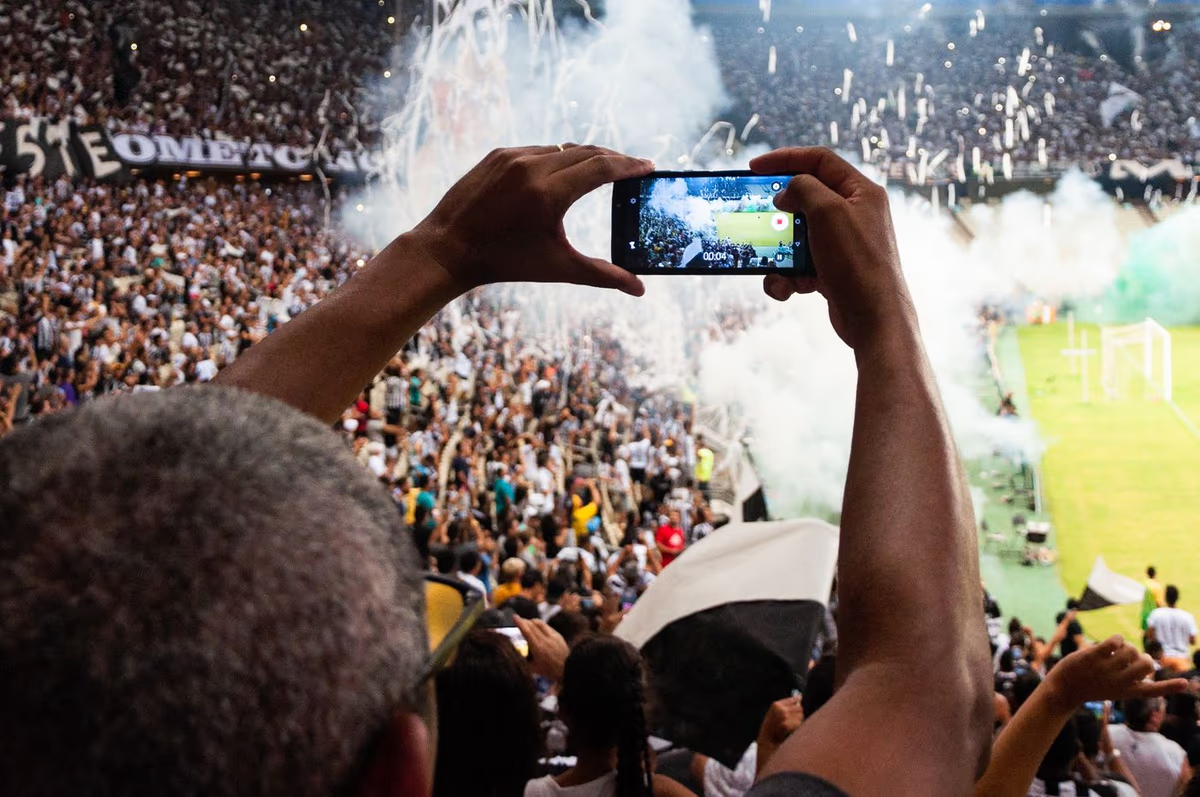
As for watching in Thailand, this year is different — JAS and Monomax secured FIFA broadcast rights in Thailand through 2030, covering all 104 matches via streaming platforms (LINE Today). Following Asian stars like Al-Taamari, or a minnow toppling a giant, now lives mainly on phone screens rather than the traditional free-to-air TV of past tournaments.
Who to watch to get the most out of it
A good player to watch is measured not by name but by how often they change a game — Mbappe every 75 minutes, Yamal generating Spain’s highest xG at 18, Mora younger than anyone who has ever stepped onto a World Cup pitch.
And remember this World Cup is a crossing point between two generations — when Messi won his first European trophy in 2006, Gilberto Mora had not even been born. Now they stand on the same World Cup stage, one bowing out and one just beginning. That is what makes this tournament special: watching the legends close their chapter and the next stars light theirs at the same time.
Before the first match kicks off, do a little homework:
- Dig into deeper stats for every nation and player on the stats page and the teams page
- To see who is favourite for the scoring race, read the Golden Boot race
- To compare them with the icons before them, read the 10 greatest World Cup players of all time and see who landed in this year’s group of death
The next great star might be a name nobody is saying today — and that is exactly why you watch from the very first match.
Sources
- Spain squad announcement for World Cup 2026 — FIFA — FIFA, 2026
- Norway at World Cup 2026 (Haaland, ending a 28-year wait) — FIFA — FIFA, 2026
- Player 2025-26 season stats (Yamal, Guler and more) — StatMuse — StatMuse, 2026
- Jordan World Cup 2026 team guide (Al-Taamari) — The Guardian (9 Jun 2026) — The Guardian, 2026
- Gilberto Mora (born 2008), Mexico's youngest player — Wikipedia — Wikipedia, 2026
- JAS and Monomax secure FIFA rights in Thailand to 2030, all 104 matches — LINE Today — LINE Today, 2026
FAQ
- Who is the must-watch player at the 2026 World Cup?
- Kylian Mbappe (France) is rated the premier individual talent — in 2025-26 he scored 42 goals in 44 matches across all competitions for Real Madrid, a direct goal contribution roughly every 75 minutes. Lamine Yamal (Spain), Jude Bellingham (England), Vinicius Jr (Brazil) and Lionel Messi (Argentina) follow (as of June 2026).
- Is Haaland playing at the 2026 World Cup?
- Yes. Norway qualified for the finals for the first time in 28 years, with Erling Haaland scoring 16 goals in qualifying — one of the most dangerous finishing points in the tournament (qualification confirmed by FIFA).
- Who is the breakout star to watch?
- Gilberto Mora (Mexico), 17, the youngest player in World Cup history; Endrick (Brazil), 19, who scored 5 goals and 7 assists on loan at Lyon; and Arda Guler (Turkiye), 21, who recorded 9 assists in LaLiga.
- Whose final World Cup is 2026?
- Lionel Messi (38, turning 39 during the tournament), Cristiano Ronaldo (41) and Kevin De Bruyne (34) are widely seen as playing their last World Cup, with much coverage framing 2026 as a farewell tour for this generation.
- How can fans in Thailand watch the 2026 World Cup?
- JAS and Monomax secured FIFA broadcast rights in Thailand through 2030, covering all 104 matches via streaming platforms — a shift from the free-to-air era, so Thai fans follow Asian stars like Jordan's Musa Al-Taamari mainly through streams.