How FIFA Cleared Balogun to Face Belgium
Winning Score Team Published Mon 6 Jul Updated Mon 6 Jul
Twelve red cards at this World Cup.
Eleven of them cost the player the next match. That is the rule.
One did not.
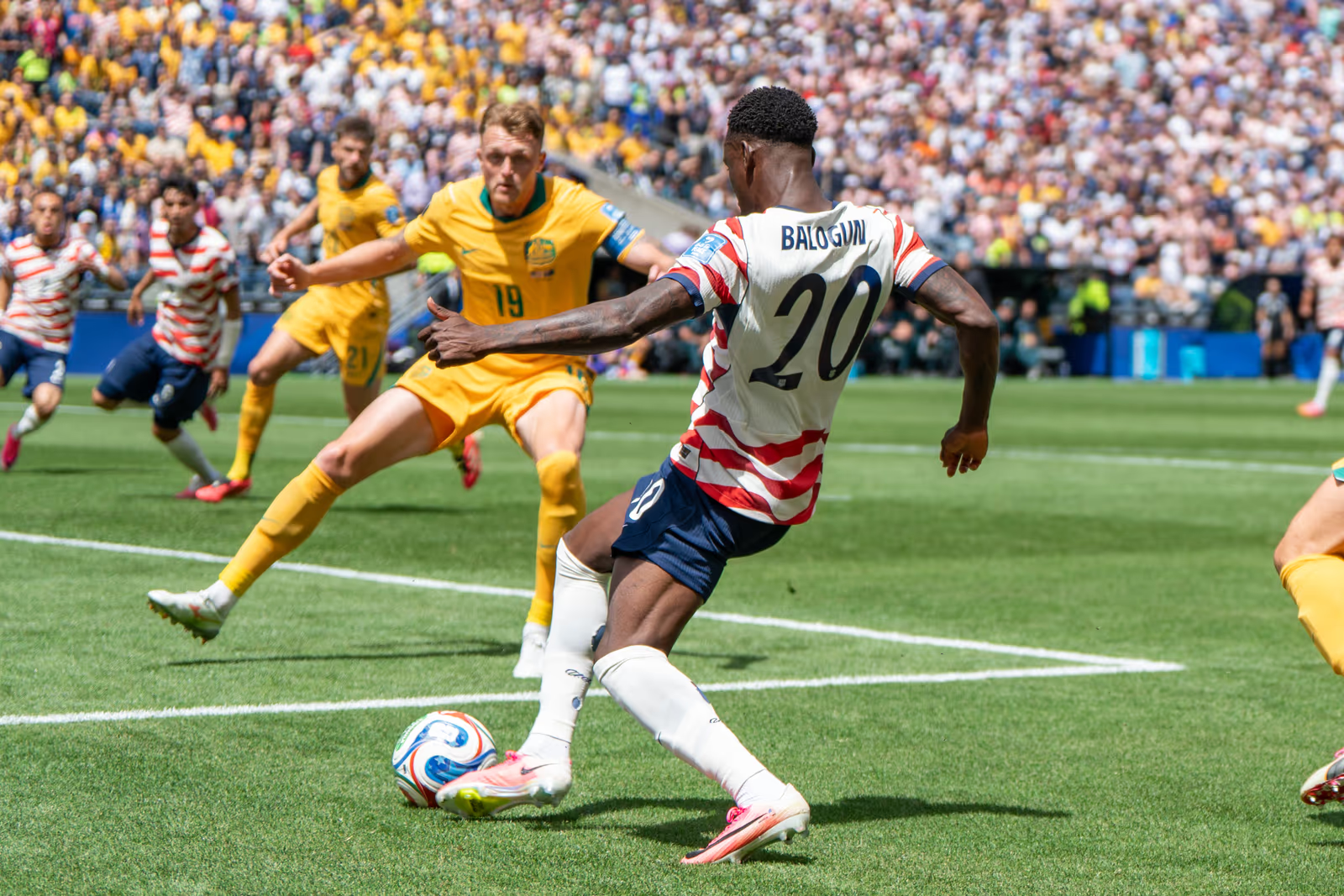
The name on that card was Folarin Balogun.
Football had always treated a red card as an automatic ban, with no appeal and no exceptions. Then, on Sunday evening, FIFA made the whole sport rewrite that assumption.
The short version
- Folarin Balogun, the United States forward, was sent off during a 2-0 round-of-32 win over Bosnia and Herzegovina on 1 July.
- The card carried an automatic one-match ban, but FIFA invoked Article 27 to suspend the punishment and replace it with a one-year probation, freeing him to play on.
- Next up: USA vs Belgium, round of 16, in Seattle. Kickoff 5:00 PM PT Monday (07:00 Thailand time, Tuesday 7 July).
- Belgium and UEFA pushed back hard; UEFA called it crossing “a red line” and “unprecedented.”
- Reports, still unconfirmed, say Donald Trump phoned FIFA’s president to ask for a review. FIFA denies politics played any part.
- The last time a World Cup red card did not end in a ban was 1962, a full 64 years ago.
A rule at war with itself
The word doing the most damage here is “overturned.”
FIFA did not overturn the red card. The red card still stands, letter for letter.
What it touched was the punishment attached to the card.
Normally a World Cup red card drags an automatic one-match ban behind it. Article 10.5 of the 2026 Competition Regulations and Article 66.4 of the FIFA Disciplinary Code say the same thing: sent off, banned from the next game, automatically. A FIFA spokesperson even confirmed after the Bosnia match that teams have no route to appeal.
Then FIFA reached for a different clause. Article 27 lets the Disciplinary Committee “suspend the implementation” of any sanction and swap it for probation of one to four years. Balogun got one year. Reoffend in a similar way during that window and the original ban comes back.
That is the whole dispute in one sentence.
FIFA says Article 27 grants that discretion. Belgium says Articles 66.4 and 10.5 are mandatory, automatic rules that discretion cannot override, and it points out that FIFA had reaffirmed exactly that in Circular No. 16, sent to every federation on 12 May. UEFA put it most bluntly: a minimum one-match ban after a red card “is not a discretionary option.”
The number that keeps the argument alive sits right here. Twelve red cards at this tournament, nine served or serving the automatic ban, two given extra games, and Balogun the only one who walks free (USA Today).
Back to the 64th minute in Santa Clara
It all started at Levi’s Stadium, Santa Clara.
Round of 32, United States against Bosnia and Herzegovina. Balogun opened the scoring in the 45th minute; the game finished 2-0.
Then, in the 64th minute, everything turned.
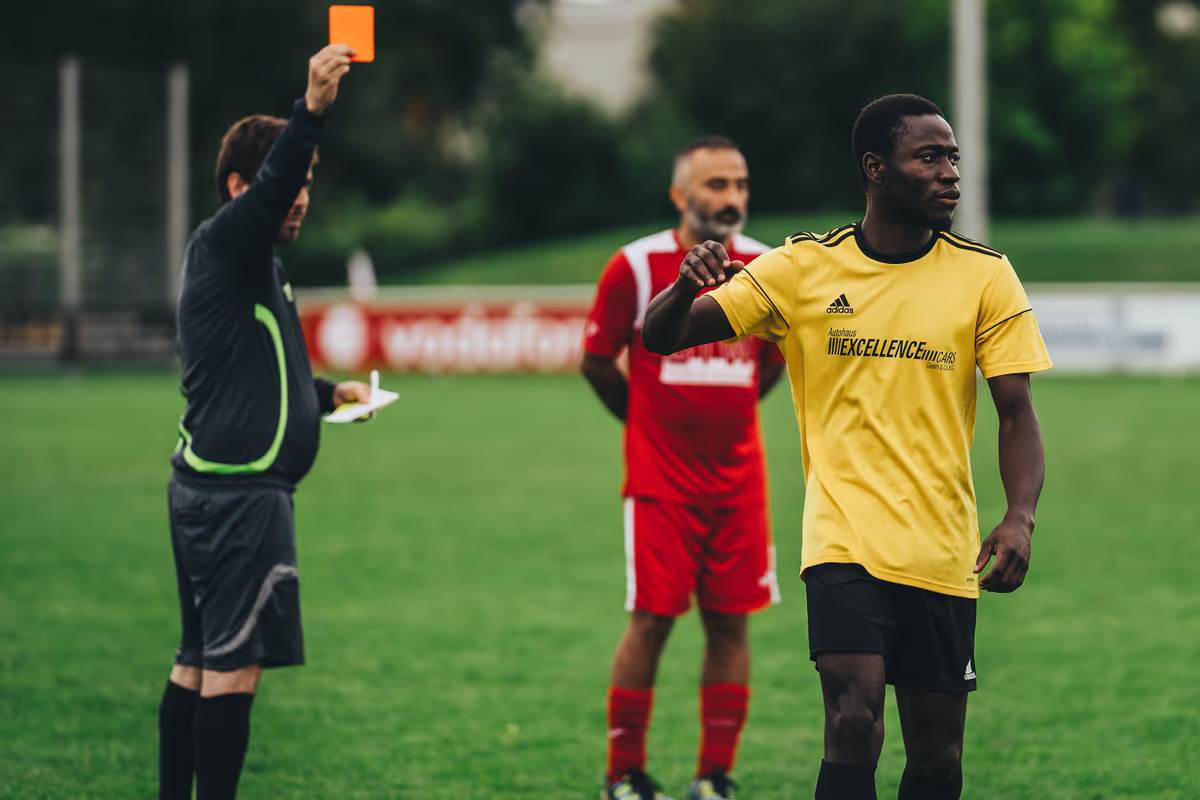
Brazilian referee Raphael Claus waved play on at first, until VAR sent him to the pitchside monitor. He came back with a straight red for serious foul play, after Balogun’s right foot came down on Tarik Muharemović’s ankle as the two lunged for a loose ball.
The pushback was instant. ESPN’s VAR analyst, a former referee, wrote plainly that it was “not a red card”, but an accidental collision from a normal challenge for the ball (ESPN). Teammate Christian Pulisic was even shorter: “zero intent at all.”
The United States played roughly 30 minutes a man down and still closed it out, Malik Tillman curling in a free kick in the 82nd.
So Balogun was both the man who scored and the man who was sent off, in the same game.
The reaction heard across the game
Sunday morning’s ruling set off responses from every direction.
The Royal Belgian FA said it was “astonished” and was “investigating all potential options,” arguing the decision clashed with the mandatory Articles 66.4 and 10.5 (RBFA).
Belgium coach Rudi Garcia turned to sarcasm: “I didn’t know that 5 July was equal to 1 April at FIFA,” noting that his own defender Nathan Ngoy had served a normal ban for a red card against Iran. Goalkeeper Thibaut Courtois was cooler: “Nothing changes; we remain focused on winning the match on the field.”
From Europe, UEFA delivered the heaviest words of all, calling the ruling a crossing of “a red line,” “unprecedented, incomprehensible and unjustifiable,” and warning that it sets a precedent mid-tournament (UEFA).
On the other bench, US coach Mauricio Pochettino welcomed it: the team was “punished enough” playing 30 minutes with ten men “in a decision that was completely unfair,” he said, adding that sport and politics must stay separate (Straits Times).
Maybe the most telling voices came from neither side. England’s Thomas Tuchel left a question hanging: “Where does this end? Where does it stop?” Norway’s Ståle Solbakken went further: “What about the next red card? Is there going to be some committee somewhere that takes that away too?”
How Trump entered the story
The thread that carried this off the sports pages began the day after the red card.
On 2 July, US Secretary of State Marco Rubio told reporters, on the record, that the team “got screwed with that red card” and that there should be an appeals process.
Then Reuters, AP, the New York Times, Le Monde and CBS all reported that Donald Trump had phoned FIFA president Gianni Infantino to ask for a review (New York Times).
But the wording matters here.
Every one of those reports leaned on anonymous sources. They do not even agree on the day of the call. No named source has confirmed it, FIFA has never acknowledged any call, and it insists the disciplinary process is independent and cannot be swayed by outside politics.
Only one thing is confirmed on the record: after the ruling, Trump posted on Truth Social, “Thank you to FIFA for doing what was right, and reversing a great injustice.”
CNN noted in an analysis that no political figure had previously pressed FIFA over a player’s eligibility for a match this important to a host nation. The rest, who called whom and why, remains territory no on-the-record source has settled.
It has happened exactly once, in 1962
To see how rare this is, go back 64 years.
The last and only time a World Cup red card did not end in a ban was 1962 in Chile, when Brazil’s legendary winger Garrincha was sent off in the semifinal and still played the final, which Brazil won.
The context was different. Back then there was no automatic suspension, so the committee had full discretion by default. In 2026 the automatic rule exists and was in force; using Article 27 to override it mid-tournament is the part that has never happened.
Article 27 itself is not brand new. In November 2025, Cristiano Ronaldo was sent off in qualifying and FIFA used the same clause to cut his ban; Nicolás Otamendi and Moisés Caicedo had bans deferred the same way (Fox Sports).
But every one of those was in qualifying, not in the middle of the finals, and while nine other players at the same tournament had already served their automatic bans. That is the line UEFA says makes this different.
Who Balogun actually is
Through all of it, the figure at the centre has said the least.
Folarin Balogun was born in Brooklyn, New York, in 2001. His mother was seven months pregnant when her flight back to London was delayed, so he arrived on American soil before returning to grow up in England at around a month old.
His football path is thoroughly English: Arsenal’s academy from the age of 10, a loan spell scoring 21 goals for Reims in Ligue 1, then a permanent move to Monaco for around €30m in 2023. He represented England up to under-21 level, but in mid-2023 he chose the United States, the country of his birth, calling it a “no-brainer” that felt “like home.”
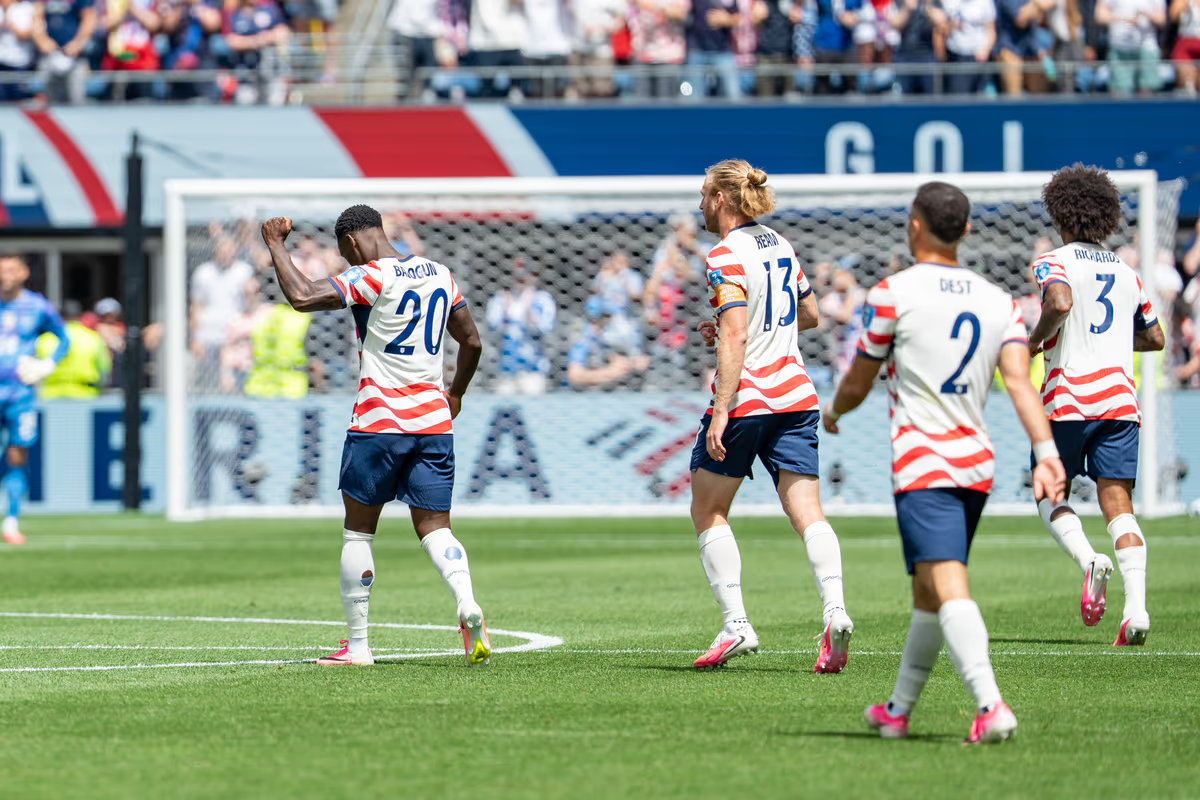
At this World Cup he has scored three times, twice against Paraguay and once against Bosnia and Herzegovina, making him the United States’ leading scorer. The Paraguay game also made him the first American to score twice in a single World Cup match since 1930.
So the Belgium game is no ordinary round-of-16 tie. It is the biggest stage of his career, and now one the whole world is watching for reasons he never chose.
The game ahead, and the question left behind
USA play Belgium in the round of 16 in Seattle, kicking off at 07:00 Thailand time on 7 July. Belgium arrived by coming from behind to beat Senegal 3-2, Youri Tielemans scoring twice, but they have conceded in every knockout game, a soft enough back line for a striker like Balogun to smell.
Off the pitch, it is not settled. Belgium has formally requested FIFA’s explanation and the referees’ report, and The Athletic reports it has been granted a right of appeal. But the practical timeline makes any injunction before kickoff almost impossible, and a post-match protest carries a very high burden with no precedent for success.
The real open question is bigger than one match. UEFA has warned that from here Article 27 must be applied equally to every remaining red card at the tournament, or it becomes two standards. The discipline framework for the rest of the World Cup wobbles along with it.
On the pitch, this game is decided over 90 minutes.
Off it, it decides something larger: whether the same rule still binds everyone equally.
Balogun will play. That much is clear. What is left hanging is who the rule was written for.
See the full knockout path on the World Cup 2026 bracket, and check where Balogun sits on the top-scorers table before kickoff against Belgium.
Sources
- FIFA suspends Balogun's ban under Article 27 — full report and timeline — AP, 2026
- UEFA official statement on the Balogun case — 'crossed a red line' — UEFA, 2026
- Royal Belgian FA (RBFA) full statement — citing Articles 66.4 and 10.5 — RBFA via Goal.com, 2026
- Trump reported to have called FIFA president to seek review — New York Times, 2026
- ESPN VAR review — 'not a red card', by a former referee — ESPN, 2026
- Article 27, the Ronaldo precedent, and the only 1962 parallel — Fox Sports, 2026
- 12 red cards at the tournament — Balogun the only one not serving — USA Today, 2026
- Pochettino welcomes the ruling — 'punished enough' — Straits Times, 2026
FAQ
- Can Balogun play against Belgium?
- Yes. FIFA used Article 27 of its Disciplinary Code to suspend the one-match automatic ban and replace it with a one-year probationary period, making Balogun available for the round-of-16 tie against Belgium (as of 6 July 2026).
- Did FIFA rescind Balogun's red card?
- No. The red card itself still stands on the record. FIFA only suspended the enforcement of the one-match ban that comes with it; it did not delete the card or rule that the referee was wrong.
- When is USA vs Belgium and where?
- The round-of-16 match kicks off at 5:00 PM PT on Monday, 6 July (00:00 UTC / 07:00 Thailand time, 7 July) at Lumen Field in Seattle, USA.
- Was Trump really involved in the decision?
- Multiple major outlets reported, citing anonymous sources, that Donald Trump called FIFA's president to ask for a review, but this has not been confirmed on the record, and FIFA says its disciplinary process is independent of outside politics. What is confirmed is Trump's Truth Social post thanking FIFA.
- How many goals has Balogun scored at World Cup 2026?
- Three, two against Paraguay and one against Bosnia and Herzegovina, making him the United States' leading scorer at the tournament.