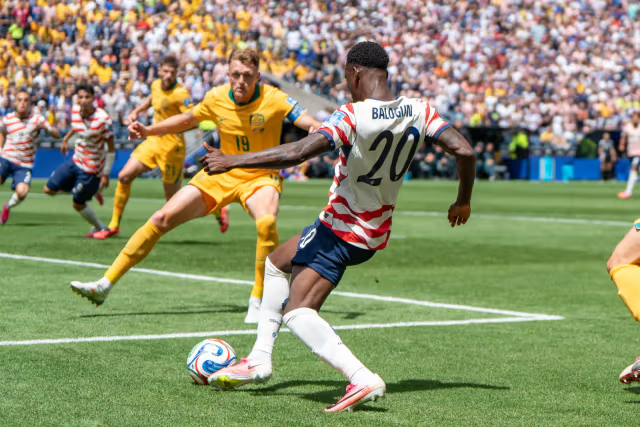
France vs Morocco QF Preview — The 2022 Rematch
Winning Score Team Published Wed 8 Jul Updated Wed 8 Jul

Al Bayt Stadium, Qatar. December 14, 2022. The fifth minute.
Théo Hernández half-volleyed a ball that had spun off Yassine Bounou’s hands into the net.
Morocco had just become the first African nation ever to reach a World Cup semi-final, and the dream started cracking in the fifth minute (BBC Sport).
Four years on, the same two nations line up against each other again — this time one round earlier, in Foxborough, Massachusetts.
The word everyone wants to reach for is “revenge.”
But the one man with the most right to say it is the one refusing to. Mohamed Ouahbi, Morocco’s coach, was blunt after knocking out Canada: “There is no revenge. We only want to continue our journey.” (Morocco World News)
Because the real target isn’t 2022. It’s ahead of them — doing what no African nation has ever done: reaching back-to-back World Cup semi-finals.
- Market-implied probabilities on the match page: France 61% · Draw 24% · Morocco 15% (as of July 5, 2026)
- France have scored 14 in five matches and conceded just two — Morocco haven’t trailed for a full 90 minutes once
- The number leans clearly to France, but it can’t see that Morocco 2026 is a different team from the one France beat
- What can quietly flip it: penalties, set-pieces, and 32°C heat — which punishes possession football more than it punishes the counter
What’s still standing since that night in Qatar
Most rematches are different squads who happen to wear the same colours. Not this one.
Théo Hernández, who scored in the fifth minute in 2022, could start at left-back again. Kylian Mbappé, whose deflected shot led to that opening goal, is still the number-one striker. Yassine Bounou still keeps goal for Morocco. Achraf Hakimi is still the captain and the marauding right-back.
The load-bearing pillars from that night are, mostly, still on the pitch tonight.
France know exactly what they’re walking into. Defender William Saliba called Morocco “one of the toughest tests” — a side that is calm and fiercely disciplined. Deschamps didn’t damn them with faint praise either: “Morocco are a very strong team. No one reaches the World Cup quarter-finals by chance.” (Morocco World News)
That kind of respect isn’t manners. It’s memory.
The 61 that isn’t our model
The match page gives France 61%, a draw 24%, Morocco 15% — and this needs saying plainly: that number is not a Winning Score model.
The World Cup has no statistical model behind it the way a league with years of data does. So the number is pure market — the consensus of money, mapped transparently onto a percentage (match page: France vs Morocco).
So what is the market reading?
The goal column. France walked into the last eight with five straight wins, 14 scored and two conceded — 3-1 Senegal, 3-0 Iraq, 4-1 Norway, 3-0 Sweden, then a 1-0 over Paraguay. And the names up front: Mbappé already has seven goals at this tournament, and 19 in World Cups overall — one behind Messi’s all-time record (Goal.com).
When one side scores in bunches and the other just survived two knockout rounds by the skin of its teeth, the market leans the obvious way.
But a market weighs the whole game — not what happens in a single moment. And that’s the seam worth prying open.
Fourteen goals against a wall that hasn’t cracked in 90 minutes
This game is a force meeting a wall, and both are more real than a five-game scoreline suggests.
Start with the force. Yes, France have 14 in five — but the last game was a warning. Against Paraguay’s two-bank low block, France had 81% of the ball and not a single shot on target in the first half. They needed a 70th-minute VAR penalty to win 1-0 — the first match all tournament they failed to score three. A well-drilled defence can turn a frightening attack into a frustrated one.
Now the wall. Morocco haven’t just avoided defeat — they’ve never trailed for a full 90 minutes at this tournament. In the Round of 32 against the Netherlands, they were 0-1 down until the 90+1st minute, when Issa Diop headed an equaliser, forced extra time, then won 3-2 on penalties — Bounou saving Summerville’s kick (Al Jazeera). In the Round of 16 they took Canada apart in the second half to win 3-0.
A force stalling against a wall that won’t crack — that’s the central puzzle of this match.
Morocco 2026 is not the team France beat
This is what the 61-15 line misses most easily: it compares France to “Morocco” — not to this Morocco.
Morocco 2022 was a deep-block side that averaged just 29.8% possession and waited to counter. Walid Regragui, the architect of that plan, resigned in March 2026. In his place came Mohamed Ouahbi, a youth coach in his first major senior tournament — and he changed the team’s face entirely: a high line, aggressive pressing, possession football that takes the game to the opponent. Reuters summed it up: this is a side “stronger than four years ago” (Reuters).
The plan France decoded in 2022 may not fully apply to the team of 2026.
But the biggest change arrived by accident. Ismael Saibari, the team’s top scorer with three goals, tore a hamstring in the 22nd minute against Canada and is a major doubt for the quarter-final (USA Today). If he can’t go, Soufiane Rahimi — who scored off the bench against Canada — steps in.
And the man who becomes the attacking hub instead is Azzedine Ounahi, who just scored his first two World Cup goals against Canada — the first from a rehearsed set-piece. Hold that detail. It comes back.
The kid France wanted to keep for a decade
Of all the names on the pitch, one is tied to both teams tighter than anyone — and he’s 18.
Ayyoub Bouaddi was born in Senlis, France. He came up through the French youth system and captained France’s under-21 side. Then, in May 2026, weeks before the World Cup, he chose to play for Morocco (NDTV).
Tonight he anchors the midfield — in the role France planned for him to hold for the next ten years — on the other side.
And he isn’t there to make up numbers. Against Brazil, Bouaddi had more touches than any teammate, passed most accurately, and carried the ball out of trouble again and again. This teenager is holding the base of Morocco’s midfield before he’s out of his teens.
So this isn’t only nation against nation. It’s a kid who chose his own path, having to prove that path against the country that raised him.
Off the scoreline: 32°C heat, yellow cards, and a strict whistle
Games at this level rarely turn on team names. They turn on the details the goal column never records — and tonight there are three layers of them.
The first is the sky. Foxborough on Thursday is forecast around 32°C, humid, with a chance of thunderstorms (AccuWeather). Remember that goalless-on-target first half France had against Paraguay? That was played in 38°C heat in Philadelphia. Heat doesn’t favour the team that has to chase and hold the ball all game. It favours the team that sits, conserves, and explodes on the break.
The second is cards. Bradley Barcola, Manu Koné and Michael Olise each carry a first knockout-stage yellow. A second one tonight means missing the semi-final (Goal.com). France have even appealed to FIFA to rescind Olise’s booking, with no ruling yet. A player carrying a caution commits to tackles a beat later than usual.
The third is the whistle. FIFA appointed Facundo Tello of Argentina, with an all-Argentine crew — the first time this tournament all five officials come from one nation (Punch Nigeria). And Tello is no card-shy referee: he’s averaging 3.2 yellows a game this World Cup, and he refereed Morocco’s 2022 quarter-final too — a game with yellows and a red.
If it goes to penalties, the number gives up
Here’s the point the percentage can’t see — because it measures “who is likelier to score more over 90 minutes,” not “how a tight game ends.”
Morocco have won two straight World Cup shootouts — Spain in 2022, the Netherlands this year. And the latest one they won despite Hakimi and El Aynaoui both missing, because Bounou saved. That isn’t temporary luck. It’s a familiarity with pressure that a goals-counting model can’t price.
Even Morocco’s route to a goal without Saibari isn’t sealed off — because it runs through dead balls. Remember Ounahi and that rehearsed set-piece? France have Saliba and Upamecano to guard the near post, but one set-piece in a game stretched tight is the tool that switches off paper superiority entirely.
Now stack it all together — heat that could make France’s possession as toothless as it was against Paraguay, a side built to sit and conserve, an elite shootout goalkeeper, and a set-piece threat that survives without a striker.
A model that only sees full-game output will underrate the 1-0 and the shootout, because it can’t see that Morocco are specialists at dragging games into exactly that territory. That’s the gap the 61-15 doesn’t tell you about.
Before the 3 a.m. alarm
This game doesn’t measure who has more stars. It measures whether France’s force breaks Morocco’s wall first — or whether the wall drags the game into its own territory first.
Three questions to weigh before kickoff.
Will France’s first half stall again, the way it did against Paraguay, in 32°C heat that doesn’t favour the team holding the ball?
Does losing Saibari make Morocco weaker — or just shift their threat toward set-pieces France may not be set up for?
And if 90 minutes settles nothing, who holds the better penalty hand — the side that has just won two shootouts in a row, or the side that would be proving it cold?
If you trust the force and edge of a France attack that has scored 14, lean one way. If you trust Morocco’s defensive order, their set-pieces, and their knockout nerve, lean the other. The number has picked a side — which side you believe is yours to decide.
See every outcome and the latest numbers on the France vs Morocco match page, trace the whole knockout path on the World Cup 2026 bracket, then revisit France’s earlier form in the France vs Sweden preview and follow the Atlas Lions’ road here in Morocco’s World Cup journey.
Sources
- France 2-0 Morocco, 2022 World Cup semi-final — BBC Sport, 2022
- Ouahbi — 'There is no revenge. We only want to continue our journey' — Morocco World News, 2026
- Deschamps — 'Morocco are a very strong team, no one reaches the QF by chance' — Morocco World News, 2026
- Morocco under Ouahbi — high press, possession, unlike 2022 — Reuters, 2026
- Saibari hamstring injury vs Canada, major doubt for the QF — USA Today, 2026
- Tchouaméni thigh injury, QF participation 'highly uncertain' — ESPN, 2026
- France vs Morocco preview + predicted XIs + Mbappé/Olise stats — Goal.com, 2026
- FIFA names all-Argentine officials for France vs Morocco — Punch Nigeria, 2026
- Bouaddi, 18, chose Morocco over France weeks before the World Cup — NDTV Sports, 2026
- Morocco beat the Netherlands 3-2 on penalties — Al Jazeera, 2026
FAQ
- What time is France vs Morocco (World Cup 2026), and where?
- The quarter-final kicks off at 16:00 EDT on Thursday, July 9, 2026 (20:00 UTC) at Gillette Stadium in Foxborough, Massachusetts. For fans in Thailand that is 03:00 on Friday, July 10.
- Have France and Morocco met at a World Cup before?
- Yes — most recently in the 2022 World Cup semi-final in Qatar, where France won 2-0 through Théo Hernández (5') and Randal Kolo Muani (79'). This is the rematch, one round earlier.
- Who is missing for each side?
- Morocco may be without top scorer Ismael Saibari (3 goals), who hurt his hamstring against Canada. France are sweating on holding midfielder Aurélien Tchouaméni, out with a thigh injury. Both starting XIs firm up about an hour before kickoff.
- Who does the winner play in the semi-final?
- The winner advances to semi-final M101 against the winner of Spain vs Belgium (M98). That semi-final is scheduled for around July 14, 2026 in Dallas.