Portugal vs Spain: The Wall That Hasn't Cracked
Winning Score Team Published Sat 4 Jul
Four games into the 2026 World Cup, Spain have not conceded a single goal.
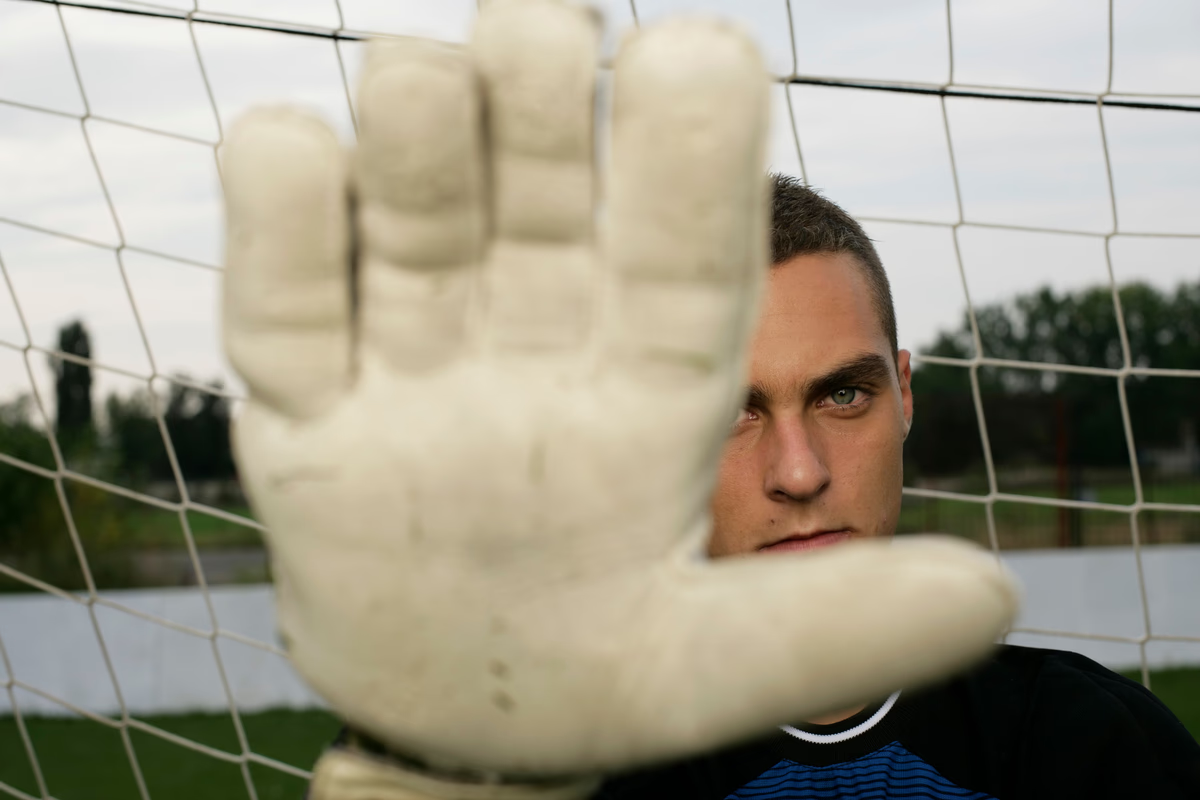
Unai Simón has stood in that goal for 519 minutes without the ball beating him, breaking a World Cup record Italy’s Walter Zenga set 36 years ago (ESPN).
But the prettiest number of the tournament hides a question nobody has answered —
The wall hasn’t cracked because nobody good enough has swung at it yet.
On Monday afternoon in Dallas, Portugal are that team.
The bottom line before kickoff
- Market-implied probability on the match page: Spain 50% · Draw 26% · Portugal 23% (as of July 3, 2026).
- The number leans Spain — but it measures a wall no elite attack has truly tested. None of Spain’s first four opponents rank inside the world’s top 15.
- Portugal have four ways in: aerial set pieces, Rafael Leão’s counter-attacking pace, wide overloads down both flanks, and the invention of Bruno Fernandes.
- Last eight meetings: Spain W2, D6 — Portugal have not won in normal time, yet beat Spain on penalties to lift the 2025 Nations League.
- The silent swing factor is a red card — Iberian derbies run hot, and this World Cup has already shown 8 reds through just two matchdays.
A 519-minute wall — that has never truly been shot at
Spain’s clean-sheet run reads like solid steel. Four games, eight scored, none conceded, Simón unbeaten for 519 straight minutes.
Look closer, though, and the story flips.
Across four games, Spain’s opponents have put just three shots on target. Simón has made four saves in the whole tournament (USA Today). Against Austria in the Round of 32, he made none at all.
So the wall needs a more honest definition — this clean-sheet run is not the work of a goalkeeper. It is the work of a system.
Rodri screens the back four from the pivot, the centre-backs split and recycle, and the press suffocates opponents before they can build. Simón barely works because the ball never reaches him.
The one flaw in the record is the opposition that built it.
Cape Verde (a World Cup debutant), Saudi Arabia, an injury-ravaged Uruguay, and Austria — not one of them sits inside FIFA’s top 15. The wall has never faced an attack fast enough, heavy enough, and varied enough to genuinely stress it.
Spain know this better than anyone, because their tournament opened with Cape Verde — a half-million-person island nation — holding them 0-0 despite Spain taking 27 shots (revisit the night before the wall existed in our Cape Verde hold Spain preview).
From that night to four straight clean sheets, Spain turned from a team that couldn’t score into a team nobody can score against.
Portugal are the first real test.
How Spain’s goal actually opens
If this wall cracks, it cracks in one of four ways — and Portugal hold all four cards.
The first is the air. Gonçalo Ramos headed the 94th-minute winner that knocked Croatia out, beating a taller defence with timing and power (Reuters). Add Bruno Fernandes’ elite dead-ball delivery and you have the one route that beats a side which barely allows an open-play shot — because a set piece resets the game into a new equation Spain’s press cannot touch.
The second is speed. Leão runs in behind a high line in a blink, and a high line is exactly what Spain play. Their 34-match unbeaten streak has never been probed by a counter-attacker this sharp.
The third is the flanks. João Cancelo and Nuno Mendes push up on both sides — the same overload mechanism that tore Uzbekistan apart 5-0 (The Indian Express).
The fourth is the brain. Fernandes is the one who can thread a pass through Spain’s midblock — if he finds the space.
But this is exactly where Portugal have two faces.
The first face is the Portugal that hammered Uzbekistan 5-0 — a fluid 4-2-3-1 with high full-backs, half-spaces overloaded, Ronaldo left as nothing but a finisher.
The second is the Portugal that drew Congo DR 1-1 and Colombia 0-0 — Ronaldo isolated, just 25 touches against Congo, the system stalled.
They unlock a low block when Roberto Martínez gets the structure right. When he doesn’t, it collapses into feeding one 41-year-old up top, which is easy to close down.
Against Spain’s wall, Portugal need the Uzbekistan version, not the Colombia one.
That is why the biggest call of Martínez’s night is one team-sheet line — start Ramos and his runs at the defensive line, or keep Ronaldo, now the oldest scorer in World Cup knockout history, through the middle.
Cracks in the wall
Spain’s wall is real. It is not seamless.
The first crack is on the wing. Yéremy Pino is out with a shoulder injury; Nico Williams is nursing a thigh problem, and the best case for him is a place on the bench (ESPN). Both first-choice wingers gone at once leaves Lamine Yamal, freshly back from a hamstring issue, and Álex Baena to carry the attack.
Yamal has climbed back to fitness a game at a time — 19 minutes, then 45, then 76, then 84 against Austria. Coach Luis de la Fuente said afterwards: “He hasn’t quite arrived yet, but he will next time” (Goal). Next time is now.
The deeper crack is the dependence on one man. Pre-tournament analysis kept flagging the same thing: on the nights Rodri is off the pitch — like the 2025 Nations League final Spain lost to Portugal — the defence “collapses.” The good news for Spain is that Rodri is fully fit and has played every minute. The bad news is there is no equivalent understudy if anything happens to him.
The last crack is the way Spain attack. Their most dangerous corridor is the left, through Marc Cucurella — but that corridor runs straight into Cancelo’s flank, so pushing forward on one side opens space on the other.
The variables that turn a game in one moment
Games at this level are rarely decided by the badge. They are decided by details the scoreline never records.
The first is the history quietly pressing on Spain. Thirteen months ago in Munich, Portugal drew Spain 2-2 and won the shootout 5-3 to take the 2025 Nations League (UEFA). Spain had 62% possession that night and twice the shots on target — and lost. Spain’s own players told their coach Portugal were the toughest side they had faced.
That scar has not healed. And it feeds directly into this game.
The second is two generations on one pitch. Yamal at 18 and Ronaldo at 41 are 23 years apart (Sporting News). One is a last tournament, the other a first the world is watching. They will not mark each other, but the symbolism is sharp — tonight decides whether the old guard bows out or the new one is stopped.
The third is the heat of an Iberian derby. Portugal and Spain are neighbours who never meet quietly, and they meet in the Round of 16 — the earliest exit point there is. One of European football’s heavyweights goes home at the first knockout hurdle, despite both arriving in good form.
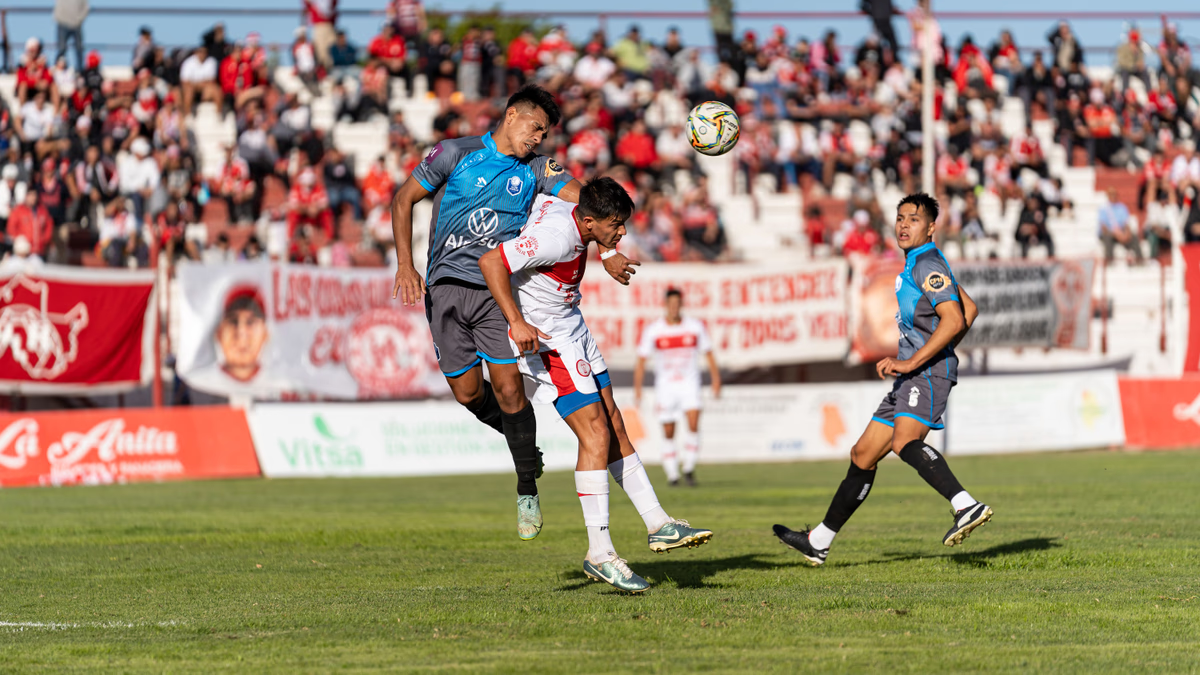
Put all three in one box — an 80,000-seat enclosed stadium in Texas, a Monday afternoon in the U.S., and two sides who refuse to go home early.
Where the number goes blind
The match page gives Spain 50%, the draw 26%, Portugal 23% — and this needs saying plainly: that number is not a Winning Score model. The World Cup has no statistical model behind it the way a league with years of data does. The figure is pure market consensus, mapped transparently into percentages.
What the market reads is what the scoreline reads — Spain conceding none in four, unbeaten in 34; Portugal blowing hot and cold.
But there is one variable a percentage cannot see, because it looks at the whole game rather than the single second when everything changes.
That variable is a red card.
The 2026 World Cup has already produced at least 8 reds in just two matchdays, and a new rule this cycle adds a trigger — cover your mouth during a confrontation and you can be sent off (AS). In a derby this charged, those triggers pull easily.
A Spanish centre-back dismissed for a last-man foul on Leão in transition resets the entire equation. A Portuguese player sent off for reacting to a hard challenge tilts it the other way.
A goals-only model underweights this, because it treats each match as independent. The human reality is that an Iberian knockout derby — Ronaldo’s farewell and Yamal’s arrival both in play — is precisely where discipline fractures.
That is the gap that makes this tie closer than 50-23 suggests.

How to read it
This game does not measure who has more stars. It measures whether Spain’s wall stands for 90 minutes, or whether Portugal prise out one moment — one set piece, one counter, one red card — before it does.
Two ways to weigh it before the ball rolls.
If you trust Spain’s system, with a fully fit Rodri, to keep Portugal from a real shot the way it has for four games — one path is clear.
If you trust the aerial threat, Leão’s pace, or the heat of the derby to hand Portugal the single moment they need — the other carries just as much weight.
Four games in, nobody has scored on Spain.
Tonight leaves one question — will Portugal be the first, or will the wall stand one more night?
See every outcome and the latest numbers on the Portugal vs Spain match page, trace all the knockout routes on the 2026 World Cup bracket, and go back to where this wall began in our Cape Verde hold Spain preview.
Sources
- Unai Simón sets World Cup clean-sheet record (519 minutes) — ESPN, 2026
- Spain's near-impenetrable defence — 19 shots faced, 3 on target, 4 saves in 4 games — USA Today, 2026
- Martínez's tactical switch — Ramos' late winner past Croatia — The Indian Express, 2026
- Ramos scores 94th-minute winner, Portugal reach the last 16 — Reuters, 2026
- Spain's double winger blow — Pino and Nico Williams — ESPN, 2026
- Portugal beat Spain 5-3 on penalties, 2025 Nations League final — UEFA, 2025
- World Cup 2026 red-card and suspension watchlist — AS, 2026
- Ronaldo's record versus Spain across 10 career meetings — Sporting News, 2026
FAQ
- What time is Portugal vs Spain at the 2026 World Cup?
- The Round of 16 tie kicks off at 3:00 PM ET on Monday, July 6, 2026 (7:00 PM UTC) at AT&T Stadium in Arlington, Texas — a fully enclosed, climate-controlled venue, so the July heat outside is not a factor.
- How long have Spain gone without conceding?
- Four straight games at the 2026 World Cup. Goalkeeper Unai Simón has kept a clean sheet for 519 consecutive minutes, breaking Walter Zenga's 36-year-old World Cup record of 517 (Italy, 1990). Yet Simón has made only four saves in four games — the system smothers shots before they form.
- What is the head-to-head record between Portugal and Spain?
- Across the last eight meetings in all competitions, Spain have won two and drawn six; Portugal have not won in normal time. But the two penalty shootouts split one apiece — Spain in the Euro 2012 semi-final, Portugal in the 2025 Nations League final.
- What is the marquee duel to watch?
- Lamine Yamal (18) of Spain and Cristiano Ronaldo (41) of Portugal, 23 years apart. They first met in the 2025 Nations League final, where Ronaldo scored and Yamal did not. This is the sequel — one generation exits or the other is stopped.