Brazil vs Norway: The Ghost of 1998
Winning Score Team Published Fri 3 Jul Updated Fri 3 Jul
Marseille, June 23, 1998. Brazil had led for most of the night.
Then, in the final minutes, Tore André Flo equalised — and Kjetil Rekdal placed the ball on the penalty spot.
He scored. Norway beat the world champions 2-1 (The New York Times).
Twenty-eight years later, the same two nations meet again — this time in the 2026 World Cup Round of 16 in New Jersey.
And this time, lose and you go home.
The short version
- Market-implied probabilities on the match page: Brazil 51% · Draw 27% · Norway 23% (as of July 1, 2026)
- The number leans to Brazil, but not by a mile — and it can’t see that this Brazil is without Paquetá, sweating on Raphinha, and short of a natural right-back
- Norway are the only team to face Brazil repeatedly and never lose — won 2, drawn 2 across four meetings
- But Norway 2026 leak goals: they conceded 8 in the group stage, the most of any team to reach the Round of 16
- What can quietly flip it is the air — Haaland (6’4”) and Sørloth (6’3”) in a crowded penalty box
The one team Brazil could never beat
This history is short, and it only leans one way.
Brazil and Norway have met four times in all competitions. Norway have won two and drawn two — and never lost (11v11).
No nation that has played Brazil more than once has a better record against them.
The famous night was 1998, at the Stade Vélodrome in Marseille. Brazil led through Bebeto on 78 minutes; it looked done. But Tore André Flo headed an equaliser on 83, and on 89 he was pulled down in the box by Júnior Baiano. Penalty. Kjetil Rekdal drove it home (The New York Times).
One detail people forget: Brazil weren’t eliminated that night. They had already topped Group A. The team knocked out by Norway’s two late goals was Morocco. Norway finished second and lost 0-1 to Italy in the Round of 16 — but that win is still remembered as the greatest in Norwegian World Cup history.
Then Norway vanished.
They missed every World Cup from 2002 to 2022 — a 28-year absence — before returning this year (FIFA.house). Their last World Cup knockout match before 2026 was that loss to Italy. And their first-ever World Cup knockout win happened just days ago, beating Ivory Coast 2-1 in the Round of 32.
This is only the second time Brazil and Norway have met at a World Cup — and the first time the two nations have played each other at all in 20 years.
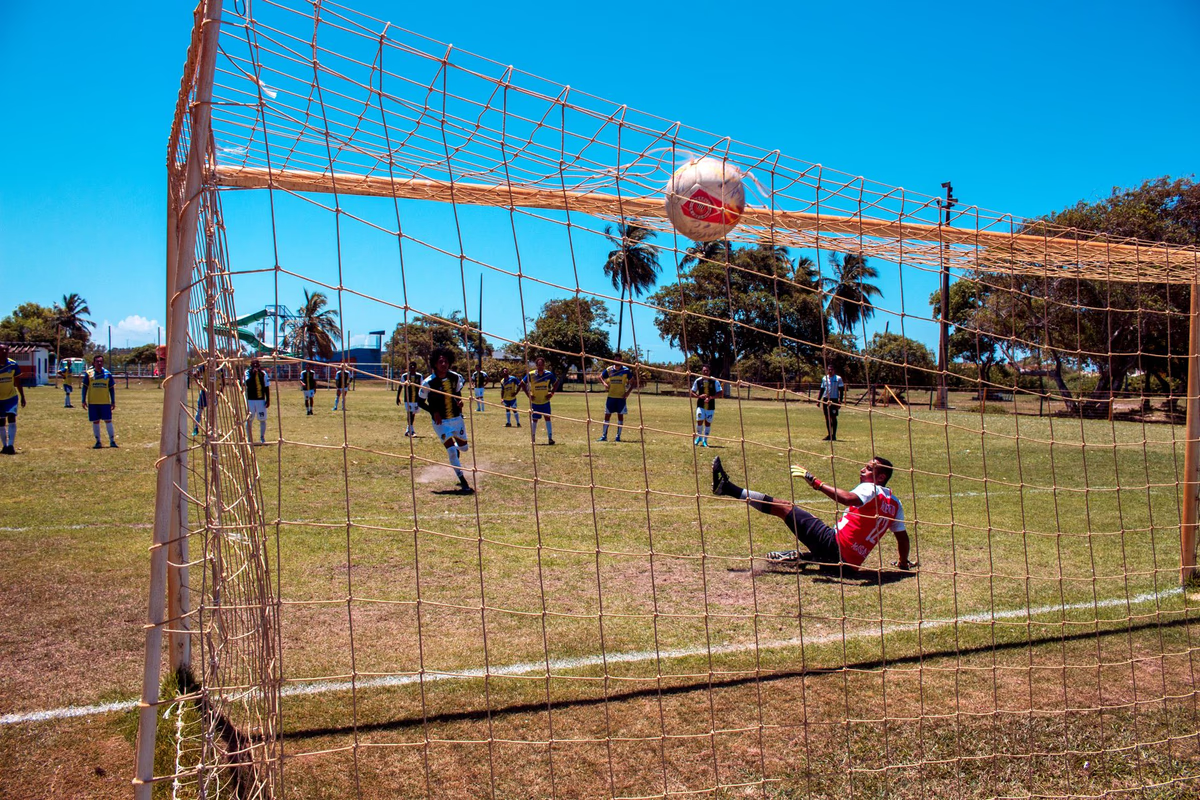
This is not the Brazil that lost that night
History may lean Norway’s way, but Brazil in 2026 no longer concede easily.
They topped their group scoring 7 and conceding 1, then showed a habit their fans rarely see. Trailing Japan 0-1 in the Round of 32, they turned it around to win 2-1 — Casemiro levelling, Gabriel Martinelli winning it in the 95th minute (Goal.com).
So redefine this Brazil: not a side that dazzles and forgets to defend, but one that endures, then kills the game late.
Vinicius Júnior leads the line with four goals and the highest xG in the squad; Bruno Guimarães has provided more assists than anyone at the tournament.
But that tidy defensive record hides three wounds.
Lucas Paquetá, who started all four games, is out with a grade-II thigh strain from the Japan tie (ESPN). He was the link to Vinicius and the man threading passes in behind. There is no like-for-like replacement; Ancelotti must shift Endrick, 19, or another body into the No. 10 role.
The second wound is on the right. Raphinha, the first-choice winger and set-piece taker, has a recurring hamstring problem and is a day-to-day doubt — back in ball work on July 1, but handled cautiously, because it is his fifth muscle issue in the same area this season (ESPN).
The third wound is the deepest: Brazil have no natural right-back left. Wesley was ruled out before the tournament, and 34-year-old Danilo — now mainly a defender — deputises there. That flank is exactly where quick attacks like to go.
And there is a yellow-card shadow on top. Casemiro and Danilo are both booked from the Japan game; a second caution here means an automatic ban for the quarter-final (Sporting News). Losing the midfield anchor and the makeshift right-back would cost more than the eye can see.
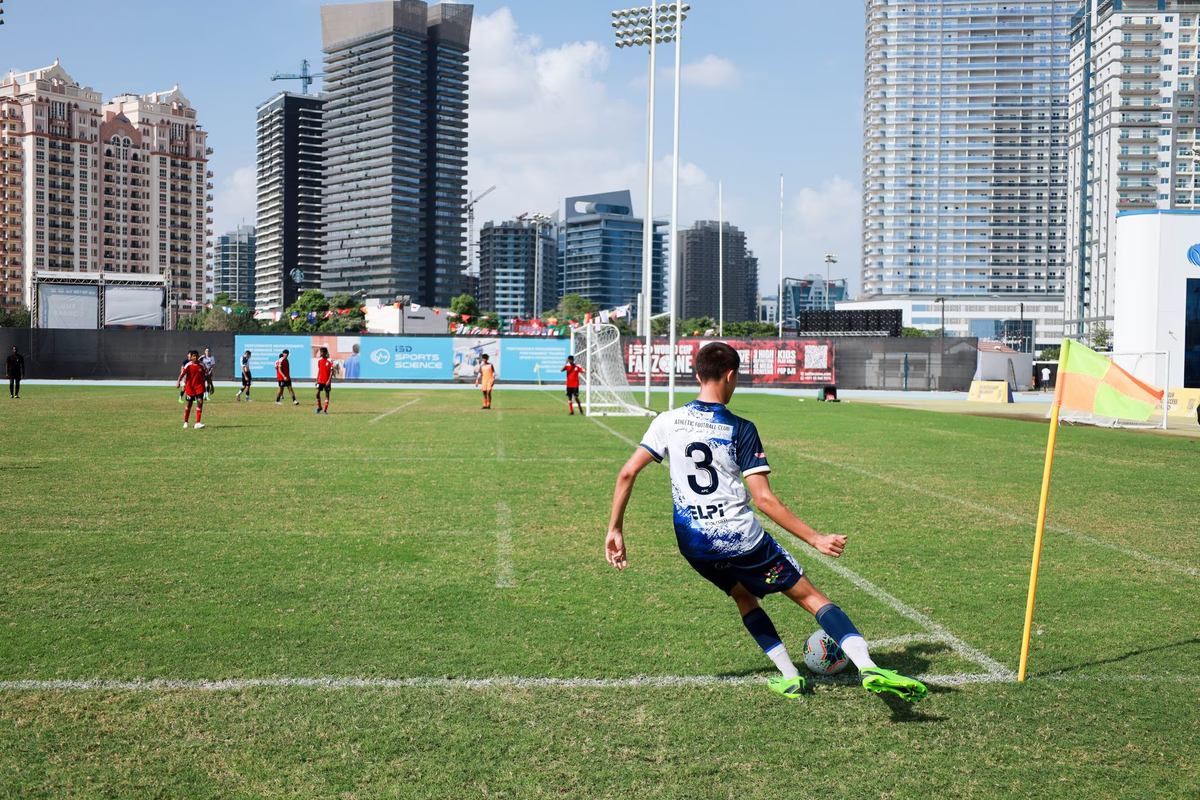
Norway waited 28 years for this
If Brazil arrive carrying a champion’s pressure, Norway arrive with something else — the sense that every minute from here is a bonus.
Erling Haaland has five goals at the tournament, including the 86th-minute winner past Ivory Coast, and he has spoken about this tie without any pretence: Norway’s chances of beating Brazil are “very slim” (India Today). That bluntness became one of the most-shared lines of the whole tournament.
Behind Haaland sit Martin Ødegaard, who has assisted in three straight games, and Antonio Nusa, who opened the scoring against Ivory Coast.
But if the attack is a gift, the defense is a debt.
Norway conceded 8 in the group stage — the most of any team to reach this round (Goal.com) — and the way they concede is a pattern: a high line, an aggressive press, and space in behind for runners. France read it perfectly and won 4-1.
Now put Vinicius into that picture.
His pace down the left is exactly the gift that fits Norway’s weakness, and that is why the market still leans Brazil.
Norway have their own right-side problem, too. Julian Ryerson — the first-choice right-back and the team’s chief set-piece deliverer — has a thigh injury from the Senegal game and is a doubt. If he misses out, Norway lose their best ball into the box for those tall heads.
And coach Ståle Solbakken has made it clear: Norway will not change their style for Brazil. They attack, and they win or lose on their own terms.
What can swing it in 90 minutes
Games of this size are rarely decided by the badge — they turn on details the score table never records.
The first is the yellow-card shadow pressing both sides: Casemiro and Danilo for Brazil, Nusa for Norway. All three are booked in the knockout stage, and a second caution tonight means missing the quarter-final (Sporting News). In a game this tense, aggression comes shadowed by the fear of a booking.
The second is the sky. MetLife on Sunday is forecast to hit around 33°C (92°F) with a chance of thunderstorms in the evening — New Jersey sat under an extreme-heat warning earlier in the week. This tournament has already seen a France game paused for two hours by storms. Heavy rain and a slick surface can turn a pace game into a battle of strength and set-pieces in an instant.
The third is the crowd. Brazil have already played here — the opener against Morocco drew 80,663 — and the New York–New Jersey area has a large Brazilian community, so this is not a fully neutral venue; it tilts slightly Brazil’s way. But Norway’s fans have shown they travel in numbers and make noise.
The last is the duel in midfield: Haaland against Gabriel Magalhães. The two have met 11 times in the Premier League (Man City vs Arsenal), with Haaland scoring six (Goal.com). That much familiarity means neither man surprises the other easily.
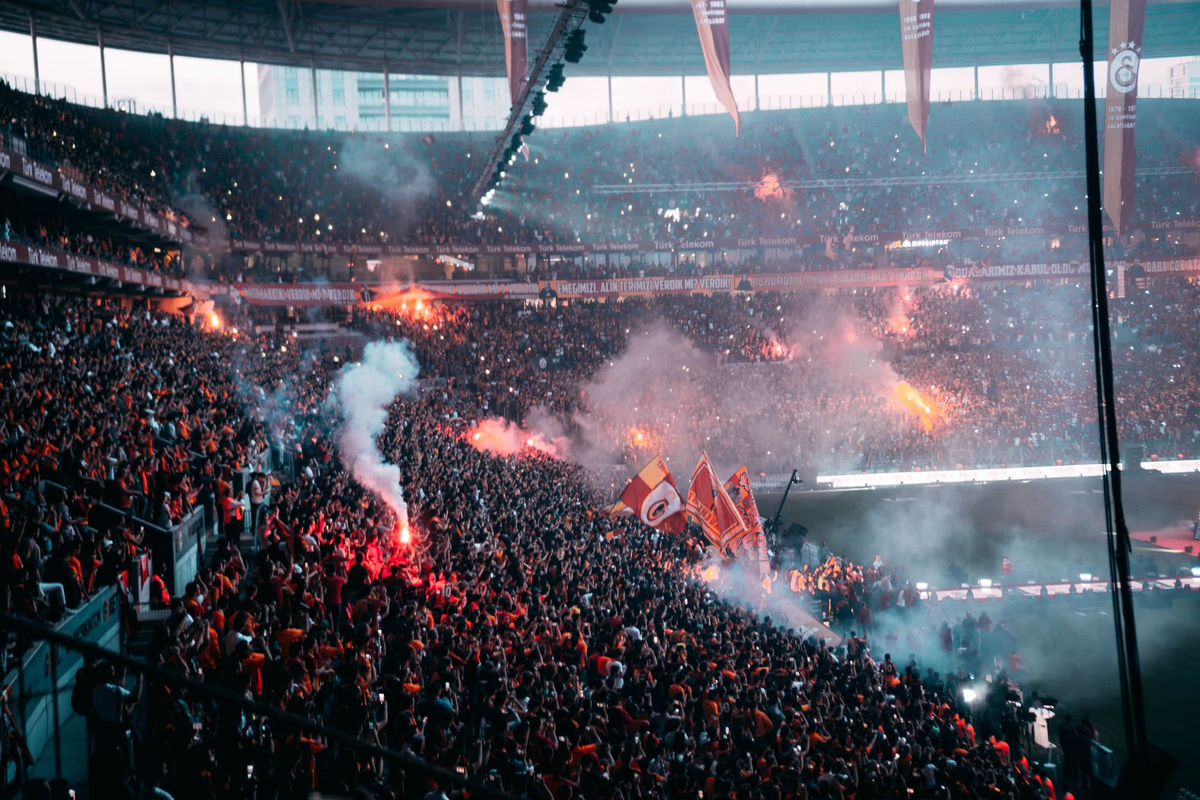
The blind spot is in the air
The match page gives Brazil 51%, Draw 27%, Norway 23% — and to be clear, this number is not a Winning Score model. The World Cup has no long-run statistical model behind it the way our league fixtures do, so the number is pure market: consensus, mapped transparently into percentages.
And what the market reads is what the goals column reads — Brazil conceded 1 in 4, Norway conceded 8. History is one thing; the shape of the teams today is another.
But there is one thing a percentage can’t see, because it looks at the whole-game total, not the single moment.
That thing is the air.
Haaland stands 6’4”; Sørloth stands 6’3”. This is one of the most dangerous aerial pairings at the tournament. Every time Norway win a corner or a free-kick into the box, the game resets into a new equation — and in that moment it doesn’t matter that Vinicius is faster than anyone; it matters that Marquinhos and Gabriel have to mark both giants at once, from different angles.
A goals-only model rates that low, because it reads like a “fluke” in the aggregate. In reality, one set-piece goal in a tight knockout is exactly the tool that switches off a paper advantage entirely.
That is the gap that makes this closer than 51–23 suggests.
How to read it when the ball rolls
This game won’t measure who has more stars. It measures whether Brazil’s pace — short of its wide tools — can crack Norway’s high line before Norway’s height produces one set-piece.
Two ways to weigh it before kickoff.
If you believe Brazil’s defensive discipline and Vinicius’s speed in behind will control the game, one path is clear.
If you believe Haaland and Sørloth in the air, plus a 34-year-old emergency right-back, can flip it in a single moment, the other path carries just as much weight.
Twenty-eight years ago, Norway wrote their greatest night with an 89th-minute penalty. Tonight there is only one question left — does history rhyme, or does a changed Brazil finally erase the ghost.
See every outcome and the latest numbers on the Brazil vs Norway match page, trace the knockout paths on the World Cup 2026 bracket, revisit Brazil’s route in the Brazil vs Japan preview, and read up on Norway’s defensive cracks in the Norway vs France preview.
The match is done — Brazil lost 1-2 and went out. Read the Brazil 1-2 Norway review to see whether the homework laid out here held up or missed.
Sources
- Norway stun Brazil 2-1, send Morocco home (World Cup 1998) — The New York Times, 1998
- All-time Brazil vs Norway record (Norway have never lost) — 11v11
- Norway return to the World Cup after 28 years away — FIFA.house, 2025
- Lucas Paquetá out of the Norway tie with a grade-II thigh strain — ESPN, 2026
- Brazil confirm Raphinha hamstring injury, return uncertain — ESPN, 2026
- Brazil vs Norway Round of 16 preview, World Cup 2026 — Goal.com, 2026
- Haaland admits Norway's chances of beating Brazil are 'very slim' — India Today, 2026
- World Cup 2026 knockout yellow-card suspension tracker — Sporting News, 2026
FAQ
- What time is Brazil vs Norway (World Cup 2026)?
- The Round of 16 tie kicks off at 4:00 p.m. ET on Sunday, July 5, 2026 at MetLife Stadium in East Rutherford, New Jersey (8:00 p.m. UTC; 03:00 on Monday, July 6, in Thailand).
- Have Brazil and Norway ever met at a World Cup?
- Once. On June 23, 1998, in Marseille, Norway won 2-1 thanks to an 89th-minute penalty from Kjetil Rekdal. Across all four meetings in all competitions, Norway have never lost to Brazil (won 2, drawn 2).
- Who is Brazil missing for this match?
- Attacking midfielder Lucas Paquetá is out with a grade-II thigh strain from the Japan game. Raphinha is a day-to-day doubt, and Brazil have no natural right-back available (Wesley is out for the tournament), with 34-year-old Danilo deputising there.
- How long had Norway been away from the World Cup?
- 28 years. Before 2026 their last appearance was France 1998, and their 2-1 win over Ivory Coast in the Round of 32 was the first World Cup knockout victory in Norway's history — earning this Round of 16 tie with Brazil.