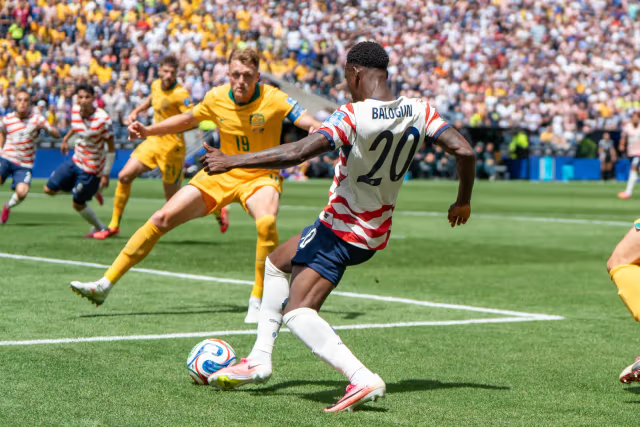
Netherlands vs Sweden: Group F's Decider
Winning Score Team Published Sat 20 Jun Updated Sat 20 Jun
The market makes Netherlands 57% favourites.
But the team sitting top of Group F right now isn’t Netherlands.
It’s Sweden — fresh off a 5-1 demolition of Tunisia.
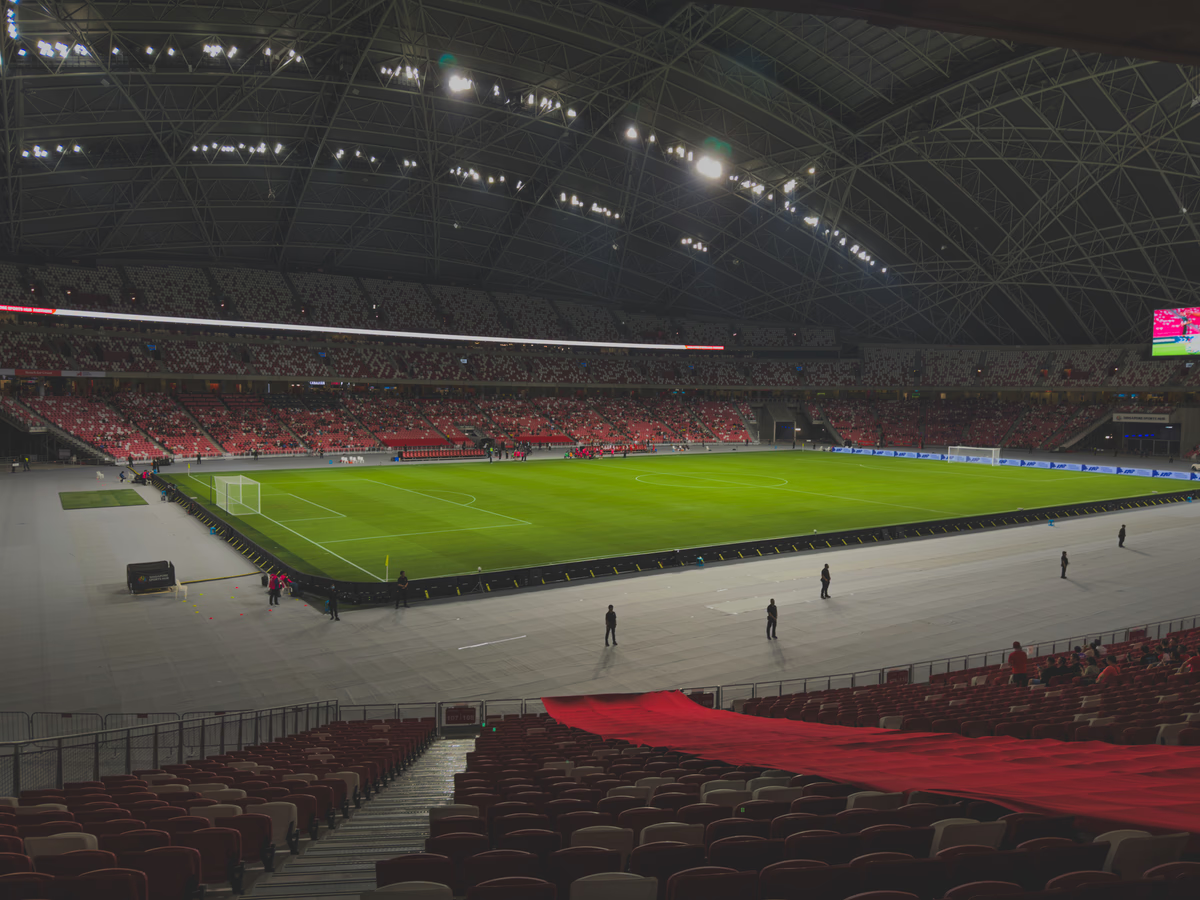
And the variable that may decide tonight isn’t a player on either team sheet. It’s the closed roof at NRG Stadium.
The 20-second bottom line
- Market-implied probabilities on the match page: Netherlands 57% · Draw 24% · Sweden 18% (as of June 2026)
- Same group, opposite starts — Sweden beat Tunisia 5-1 to lead Group F, while Netherlands were pegged back late by Japan for a 2-2 draw and a single point.
- Netherlands lose Quinten Timber to a concussion and sweat on Frenkie de Jong — the midfield hub their whole system is built around.
- Sweden arrive injury-free, the Isak–Gyökeres strike pair red-hot, with a transition machine that tore Tunisia apart on less possession.
- What the number can’t see: a closed roof plus air conditioning that turns midday Houston into a fast, cool arena, and a new tie-breaker rule that frees Sweden to play without fear.
What the number says — and what it doesn’t
On the match page, the current probabilities are Netherlands 57%, draw 24%, Sweden 18%.
This isn’t a prediction of who wins. It’s a transparent market consensus mapped to percentages — the World Cup has no Winning Score statistical model behind it the way our long-data leagues do, so this set comes purely from the market.
What does 57% actually mean?
It means even a clear favourite still has nearly a coin-flip chance of not winning, once you add the draw and the loss together.
And that number leans heavily on Netherlands’ pedigree, squad value, and possession stats — three things easy to measure, but far from the whole game. See every outcome and where the figure comes from on the Netherlands vs Sweden match page.
The rest of this piece is what the number can’t hold: who’s missing, the conditions on the pitch, and a qualification maths that weighs on the two sides anything but evenly.
The Netherlands case — a favourite that stumbled out of the gate
Netherlands opened looking like they controlled everything: 60% possession, 524 passes at 88% accuracy, captain Virgil van Dijk heading them ahead on 51 minutes, and Crysencio Summerville making it 2-1 on 64. (The Guardian)
But those commanding numbers hid a crack at the death.
After a wave of substitutions on 69 minutes, the attacking rhythm broke, the Dutch dropped into a deep block, and Japan pressed until Daichi Kamada equalised on 89. (The Guardian)
Manager Ronald Koeman took the blame head-on, saying his own changes cost the points, and promised a higher, more aggressive press against Sweden. (ANI News)
The problem: they’re about to press higher, on the night their midfield is thinnest.
Quinten Timber is ruled out after a training collision left him concussed. (ANI News)
And that isn’t even the heaviest name.
Frenkie de Jong, the Barcelona orchestrator, is a game-time decision with a stomach and lower-body complaint; Koeman openly called starting him a calculated risk. (ANI News)
De Jong isn’t just a good player. He’s the one who drops between the centre-backs to receive under pressure and beat the press — the functional bedrock of the 4-3-3. Without him, Teun Koopmeiners has to fill that role.
There is some good news: Memphis Depay, the nation’s all-time top scorer, is back from a thigh injury and played 21 minutes off the bench against Japan. (Olympics.com) The selection call that most changes the attack is whether Koeman starts him. (The Football Faithful) Depay likes to drop in and build, unlike a winger running in behind — one swap that reshapes the whole front line.
The constant is Van Dijk, who completed 95 passes and ran the air against Japan, and who’ll have to anchor against Sweden’s counters all night.
The Sweden case — fully loaded and firing
In contrast to the noise in the Dutch camp, Sweden walk into Houston with a confidence they haven’t had in years.
They beat Tunisia 5-1, and the texture was scarier than the scoreline. Alexander Isak scored a brilliant solo on 30 minutes and added two assists, while Viktor Gyökeres extended his absurd run with his 16th goal in his last 15 national-team appearances. (Sky Sports)
The real revelation was Yasin Ayari, the 22-year-old Brighton midfielder, who fired in two long-range strikes on 7 and 96 minutes; substitute Mattias Svanberg then scored 18 seconds after coming on. (The Guardian) The depth runs all the way to the bench.
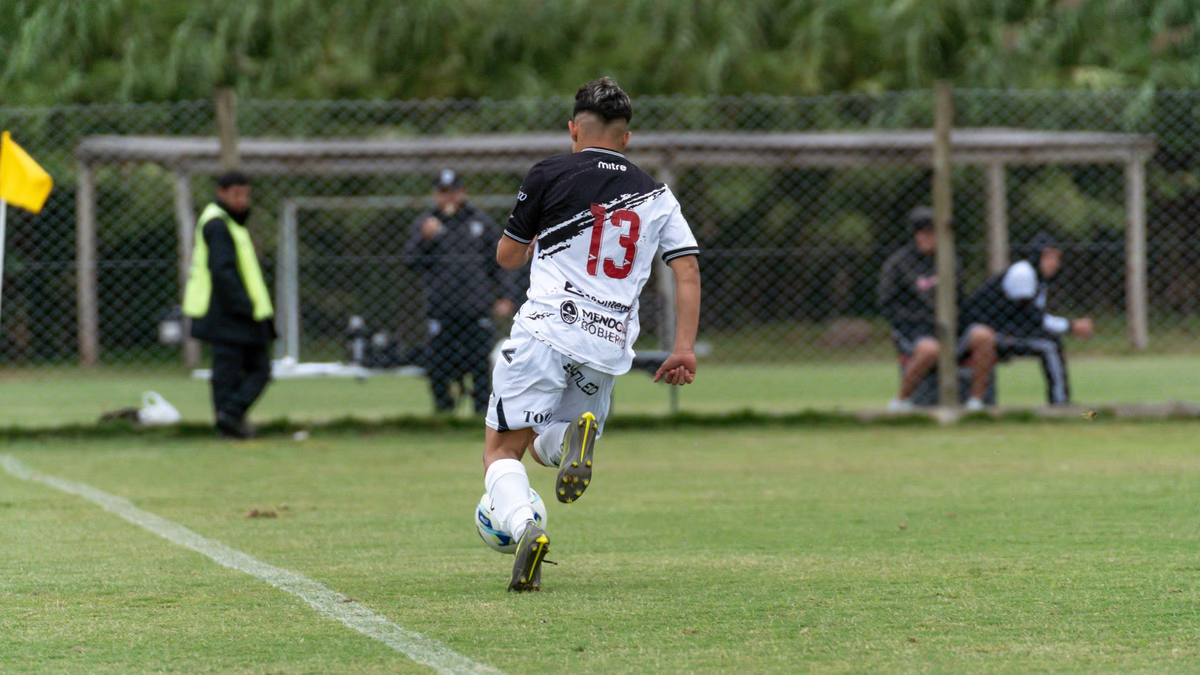
Here’s the unnerving stat: Sweden let Tunisia keep 49% of the ball and still peppered the goal. (Sky Sports) This isn’t a team that needs the ball to hurt you. It’s a team built to wait, then explode.
Manager Graham Potter — the Englishman who took over after a rocky qualifying run — sets up in a 3-4-1-2 that soaks pressure and breaks at speed, and his squad is almost fully fit. No injuries, no suspensions: Gabriel Gudmundsson (cramp) and Isak (routine monitoring) are both cleared. (The Football Faithful)
Potter framed the rout as structure, not just stardust. He praised a side that “remained calm” and pointed out that his two forwards “needed a team to function behind them” — a partnership only just forming, and already this dangerous. (Sky Sports)
So Potter has barely any reason to rotate, short turnaround or not — the group maths says this is the game to send out your best and close it down.
The variables that can flip it
This is the part the number can’t reach.
A roof shut tight. Outside, midday Houston hits 35°C with a heat index past 40°C, under a heat advisory and a thunderstorm threat. (Fly2Houston) The players won’t feel any of it. Stadium authorities confirm the roof stays closed and the venue fully air-conditioned for the tournament, to protect fans and the specially imported cool-season grass. (Football Ground Guide)
That giant icebox inverts every assumption.
Instead of heat dragging the tempo down the way a summer noon kickoff usually would, a cool sealed arena preserves sprint stamina in full. The game stays fast and sharp — conditions that suit Isak and Gyökeres’ pace far more than a patient Dutch build-up.
The qualification maths. The pressure is wildly asymmetric. Sweden lead on 3 points and +4; a win means 6 and top spot. Netherlands, already on a draw, drop to one point with a loss and then have to chase it against Tunisia while leaning on other results. (Flashscore)
More important: the 2026 rules use head-to-head before goal difference. (Flashscore) Beat Netherlands and Sweden finish above them no matter what happens on the final day — so Potter can play this without chasing goals, and rest his starters against Japan.
The history. Netherlands lead the head-to-head, four wins and two draws to a single Swedish victory. (Wikipedia) But the rawest memory is 2018 qualifying, same group: Netherlands won the home leg 2-0 through an Arjen Robben brace and still failed to reach Russia — a scar that lingers.
The referee. FIFA appointed England’s Michael Oliver, a let-it-flow official with no unusual card history that would force either side to rethink from the first whistle.
Where the number might miss
Run this through a model weighing pedigree, squad value, and possession, and it leans Netherlands. (Al Jazeera)
The blind spot in that model is a matchup of styles that fit together too perfectly.

Koeman has promised a higher press. But the higher the line, the wider the space behind it — and that space is what Potter’s system waits for. Every Dutch turnover in Sweden’s half gives Isak and Gyökeres a long runway at Van Dijk and Micky van de Ven in the open.
Worse, the cool, fast sealed pitch amplifies ground counters — the exact place a summer model assumes a transition team fades after halftime. Tonight, it won’t.
The number also can’t price Sweden’s freedom. When the new tie-breaker means one clean counter is enough, Sweden can play without rushing — absorbing all night with no reason to open up. That’s the rarest luxury at a World Cup: a side that can win the group without ever needing to chase the game.
This is what a single figure can’t tell you, and why reading a match takes both the number and the context, not one or the other.
Something to take with you
This game isn’t about who’s bigger on paper. It’s about whose style fits the pitch tonight.
If you trust Netherlands’ individual quality and depth to keep the ball and eventually prise Sweden open — that’s one path.
If you trust Sweden’s counter, plus a fast cool arena and the freedom of a friendly tie-breaker — that path carries just as much weight.
The number says Netherlands are favourites. The context says Sweden have enough to flip it.
See every outcome and the latest figures on the Netherlands vs Sweden match page, compare the whole group at World Cup 2026 groups, read which group is the real group of death in our group of death breakdown, and scan the names to watch in our World Cup 2026 star players guide.
Sources
- Koeman accepts blame for draw, awaits De Jong fitness — ANI News, 2026
- Quinten Timber ruled out of Sweden clash after concussion — ANI News, 2026
- Netherlands World Cup 2026 squad list — Olympics.com, 2026
- Netherlands 2-2 Japan — live report — The Guardian, 2026
- Sweden 5-1 Tunisia — Gyökeres and Isak — Sky Sports, 2026
- Yasin Ayari brace sinks Tunisia (match report) — The Guardian, 2026
- Netherlands vs Sweden — preview and team news — The Football Faithful, 2026
- Which 2026 World Cup stadiums have air conditioning — Football Ground Guide, 2026
- Surviving Houston summer during FIFA 2026 — Fly2Houston, 2026
- How a rule tweak gives Sweden the chance to top Group F — Flashscore, 2026
- 2026 FIFA World Cup Group F — table and data — Wikipedia, 2026
FAQ
- What time is Netherlands vs Sweden (Thailand time)?
- Kickoff is midnight, 00:00 on Sunday 21 June 2026 Thailand time (late Saturday night), which is noon local time on 20 June in Houston, at NRG Stadium, Texas.
- Why does NRG Stadium's roof matter so much?
- Outside, midday Houston pushes a heat index past 40°C, but stadium authorities confirm the roof stays closed and the venue fully air-conditioned to protect fans and the imported cool-season grass. The result is a fast, cool match with no heat fatigue to slow it down — which favours a sharp transitional side like Sweden.
- How much is at stake for each team?
- Sweden top the group on 3 points with a +4 goal difference; a win takes them to 6 and all but seals first place. Netherlands, held to a draw in their opener, must avoid defeat or they drop to one point and depend on other results in the final round.
- What are Netherlands' team problems before this game?
- Quinten Timber is out with a concussion from training, while Frenkie de Jong — the midfield hub the system leans on — is a game-time decision with a physical complaint. Xavi Simons and Jurrien Timber are out for the whole tournament through injury.