Mexico vs South Korea: The Fight for Group A
Winning Score Team Published Thu 18 Jun Updated Thu 18 Jun
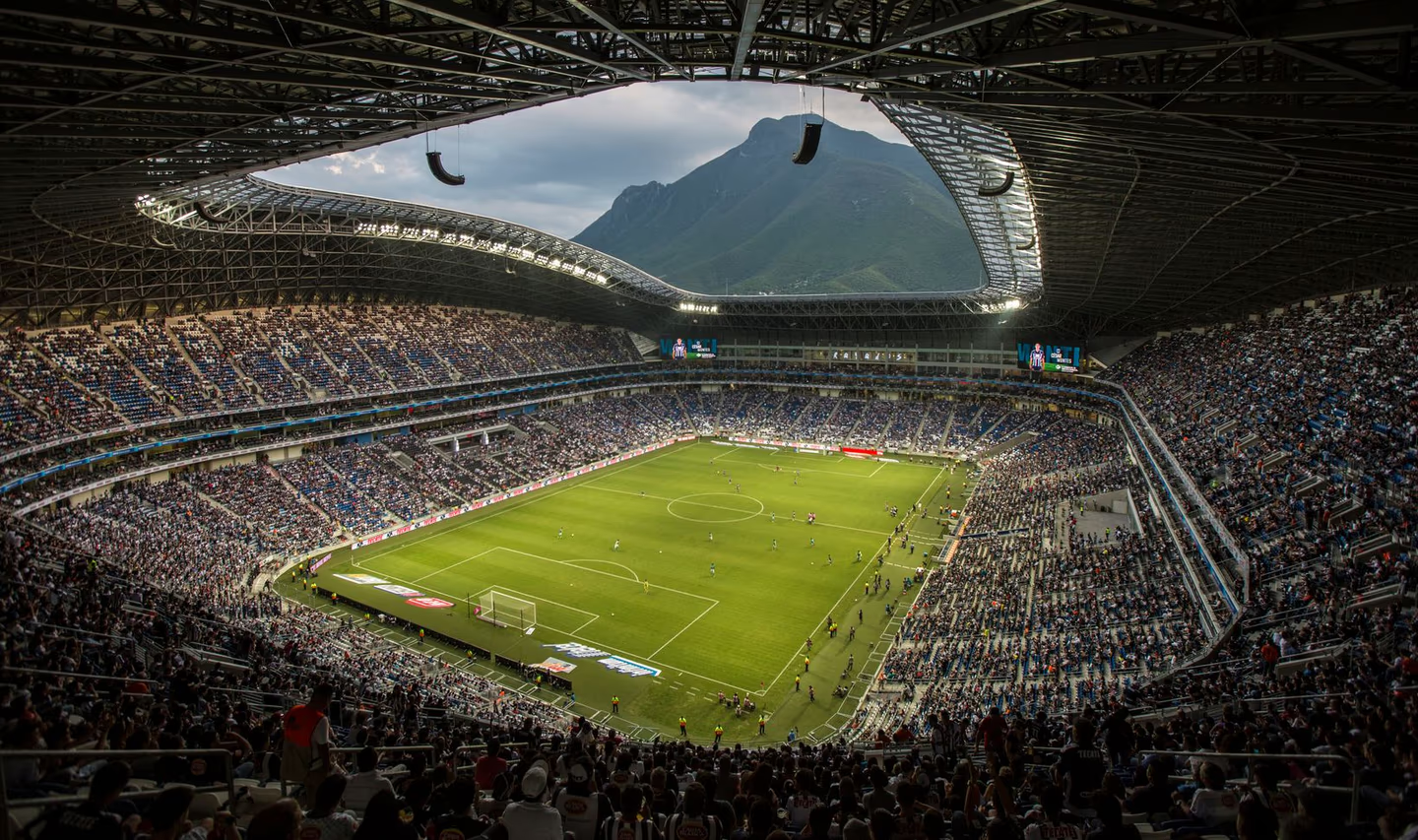
Mexico are at home. The crowd is theirs. The probability says they are favorites.
Everything points to an easy night.
But South Korea’s real opponent might not be in Mexico’s starting eleven at all.
It’s 28°C heat and 1,670 meters of altitude at Estadio Akron.
The 20-second version
- Market-implied probability on the match page: Mexico 48% · Draw 29% · South Korea 23% (as of June 2026)
- This isn’t a survival game — both teams already won. It’s a straight fight for top of Group A, and the winner all but books a Round of 32 ticket.
- Mexico lost a key man: César Montes to a red card in the opener, forcing captain Edson Álvarez back from midfield into central defense.
- Korea counter at pace — but they lost the ball 115 times in their opener. The most energy-hungry system meets the harshest conditions.
- The variable the numbers miss: heat plus altitude, which could break the game open in the final 20 minutes.
What the number says — and what it doesn’t
On the match page, the probability right now reads Mexico 48%, draw 29%, South Korea 23%.
This is not a prediction of who wins. It’s the market consensus mapped into a transparent probability (Goal).
So what does 48% actually mean?
It means even the favorite is more likely not to win than to win, once you add the draw and the loss together.
This game is closer than the phrase “home favorites” makes it feel. See every outcome’s probability and where the number comes from on the Mexico vs South Korea match page.
The rest of this article is the part the number can’t capture — who’s missing, the pitch conditions, and the pressure that never shows up in a spreadsheet.
The case for Mexico — hosts who just lost their anchor
Mexico opened with a controlled 2-0 win over South Africa: Quiñones on nine minutes, a Raúl Jiménez header on 67 (Wikipedia).
That control has numbers behind it. This side is unbeaten since November 2025 and conceded just ~0.22 goals per game across 2026 (Sofascore).
Javier Aguirre’s 4-1-4-1 is built to hog the ball and dictate tempo — 61% possession in the opener, 520 passes at nearly 90% accuracy, and 68.2% of aerial duels won (Sofascore).
The squad has fresh depth too. Álvaro Fidalgo, a Spain-born midfielder who recently cleared his residency to play for Mexico, adds creative distribution from the center, while 17-year-old Gilberto Mora has earned Aguirre’s trust as a box-to-box engine on the biggest stage (Sports Illustrated).
But the control has a crack in it.
Aguirre himself admitted the team got overconfident after going 2-0 up — the lapse that led to the chaotic finish and Montes’s dismissal.
In the 92nd minute of that opener, César Montes — first-choice center-back and vice-captain — was shown a straight red for denying an obvious goalscoring opportunity (Sports Illustrated).
That’s not just one player gone.
Montes is the best ball-player in their back line and an aerial wall. Losing him likely pulls captain Edson Álvarez out of defensive midfield and down into center-back — at the cost of the very space he used to screen.
The second problem is Julián Quiñones, the winger who scored the tournament’s first goal but limped off on 79 with a knock. He’s still day-to-day. If he can’t go, Mexico shift their left-side threat to Alexis Vega or César Huerta and lose some directness (Sports Illustrated).
The man to watch is Raúl Jiménez.
That header in the opener was his 46th international goal — joint-second on Mexico’s all-time list — and his first ever in a World Cup finals, years after surviving a fractured skull in 2020 (The Guardian).
And his aerial profile maps perfectly onto Korea’s weakness from set-pieces.
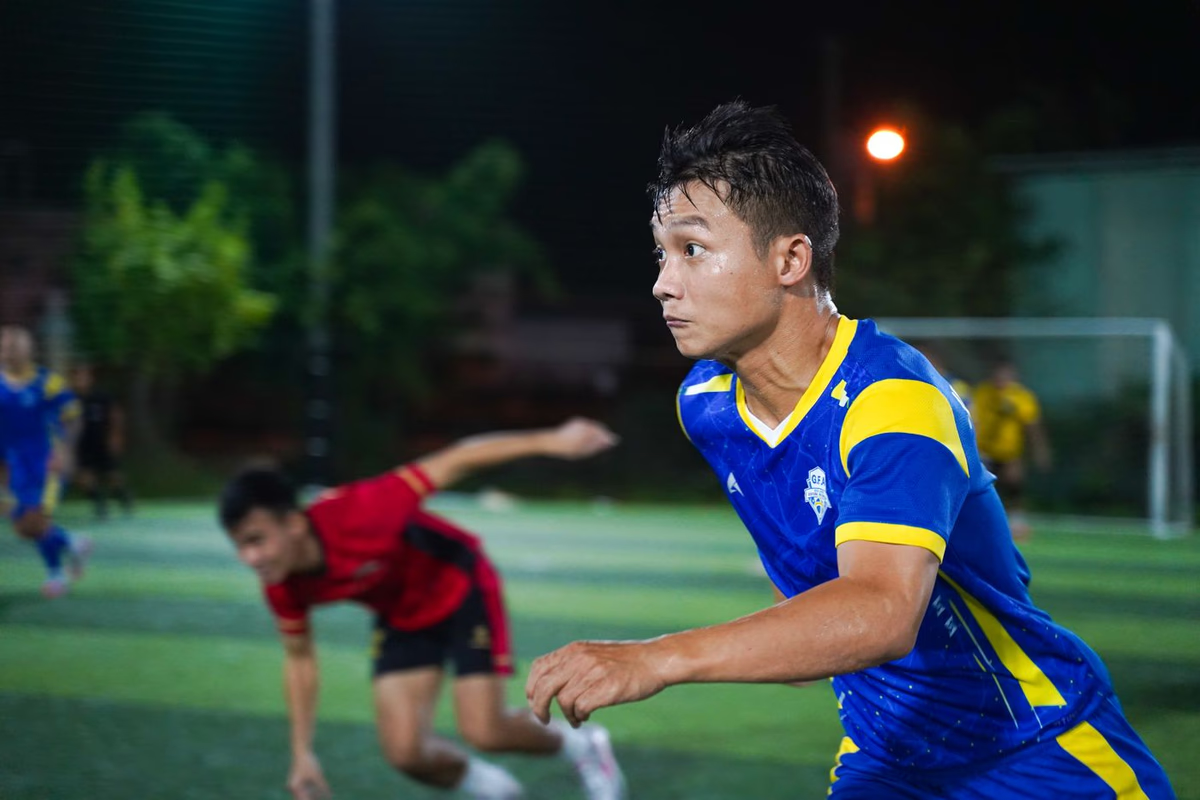
The case for South Korea — deeper now, but still fragile
Korea survived a scare in their opener, coming from behind to beat the Czech Republic 2-1 through Hwang In-beom and substitute Oh Hyeon-gyu (Wikipedia).
That night told two stories at once. This team is deep enough to win without Son Heung-min — and its system is just as high-risk.
Hong Myung-bo’s 3-4-2-1 lives on fast vertical transitions, wing-back pace, and sharp attacking midfielders. Against the Czechs it produced four big chances (Sofascore).
But a high-risk system has a bill to pay.
In that same game, Korea lost possession 115 times. Against a side passing at nearly 90% like Mexico, that forces the wing-backs into long spells of deep defending, flattening the shape into a passive 5-4-1 (Sofascore).
The defense is the worry too. Korea conceded six goals across their last five matches, especially from set-pieces, and their central depth was thinned before the tournament when center-back Cho Yu-min withdrew from the squad (Sofascore).
In midfield, Stoke playmaker Bae Jun-ho remains a question mark with an ankle issue — back in training, but unconfirmed for a start (Sofascore).
Hong’s edge is the bench. Oh Hyeon-gyu and Hwang Hee-chan, the two substitutes who flipped the opener, are likely held in reserve again — late-game weapons aimed at a tiring Mexican defense in the final half hour (Sports Illustrated). And the whole squad is playing under a manager who has openly challenged them to surpass Korea’s legendary 2002 semifinal run.
The man to watch isn’t Son — it’s Hwang In-beom.
The Feyenoord midfielder engineered the comeback almost single-handedly, scoring the equalizer and assisting the winner. He’s the connective tissue between defense and attack, with Bayern Munich’s Kim Min-jae anchoring behind him — and if Álvarez really is pulled out of midfield, Hwang inherits exactly the space that opens up.
The variables that swing it
This is the part the numbers can’t reach.
Heat and altitude. Estadio Akron sits about 1,670m above sea level — thinner air, less oxygen, slower recovery between sprints. Mexico’s Liga MX players are acclimatized to that; Korea’s largely Europe-based squad faces a real physical deficit as the game stretches on (Wikipedia).
Worse, the forecast is around 28°C — what sports science calls “performance-impairing heat,” the point where distance covered, sprint frequency, and intensity all drop. Climate Central puts an 88% chance the match is played in those conditions (Climate Central).
Korea’s counter-attacking system runs on explosive speed. Cap that speed with heat and altitude, and the gaps between their lines widen in the final 20 minutes — right when Mexico’s fresh substitutes arrive.
A card-heavy referee. FIFA appointed Uruguay’s Gustavo Tejera, who has issued 1,318 yellows across 262 matches. Tactical fouling carries a high price here — for Mexico’s physical defending and Korea’s last-ditch transition tackles alike (Sofascore).
But a 2026 rule change adds a twist: a single yellow is wiped clean after the group stage (FIFA).
Which means if either side leads late, booked players no longer fear a knockout-round ban — so the final minutes could turn more physical, not less.
History. Mexico won both prior World Cup meetings (3-1 in 1998, 2-1 in 2018). But 2018 tied the two nations together: Korea’s shock 2-0 win over Germany saved an eliminated Mexico, sending fans to thank the Korean embassy in Mexico City (The Guardian).
Friendship off the pitch is one thing. The contest on it is another — and days before kickoff, an unregistered drone was detected over Korea’s closed training camp and shot down by Mexican military, which Hong called “unfortunate,” coming at the most important moment of their prep (ANI News).
Where the number might miss
Run this game through a goals-only or xG model and you get a tight, low-scoring Mexico edge built on defensive solidity and home advantage.
But that kind of model can’t price the away side’s physical bill.
Korea’s system demands they absorb pressure and then sprint vertically. They lost the ball 115 times against the Czechs — every loss a recovery sprint. Run that system at 1,670m in 28°C heat and it becomes barely sustainable over 90 minutes.
The model will call it close on technical parity. The physical reality says Korea risks a systemic collapse in the final quarter, when fatigue shatters their defensive spacing.
That’s what a single number can’t tell you — and why reading a game means weighing both the number and the context, not one without the other.
So, how to read it
This game isn’t about who’s better on paper. It’s about who copes with the conditions better.
If you trust the hosts’ possession game to stretch the match and drain the legs out of it — plus the altitude edge and the crowd — one path is clear.
If you trust the sharpness of Korea’s counter and the bench depth they already proved in the opener — the other path holds just as much weight.
Not a survival game. Not an ordinary one. The kind where the winner all but books a Round of 32 ticket before anyone else.
See every outcome’s probability and the latest number on the Mexico vs South Korea match page, compare the whole group at the World Cup 2026 groups page, and read how Korea got here in the night Son didn’t score but the team still won, plus the bigger picture of all nine Asian sides.
The game is done — see whether this read held up in our Mexico 1-0 South Korea review.
Sources
- Mexico vs South Korea — World Cup preview — Goal, 2026
- 2026 FIFA World Cup Group A — results and table — Wikipedia, 2026
- Mexico vs South Korea preview, predictions, lineups — Sports Illustrated, 2026
- Mexico vs South Korea Group A preview (stats) — Sofascore, 2026
- Mexico vs South Korea — performance-impairing heat — Climate Central, 2026
- Estadio Akron — altitude and capacity — Wikipedia, 2026
- When do yellow cards reset at World Cup 2026? — FIFA, 2026
- Drone over South Korea's training camp before Mexico — ANI News, 2026
- From frustration to party time — Mexico ready — The Guardian, 2026
FAQ
- What time is Mexico vs South Korea at World Cup 2026?
- The Group A Matchday 2 fixture kicks off at 19:00 local time in Guadalajara on June 18, 2026 (01:00 UTC June 19, or roughly 08:00 in Thailand) at Estadio Akron.
- Why does this match matter so much?
- Both teams won their openers and sit level on three points. The winner reaches six points, which all but guarantees a Round of 32 spot with a game to spare. A draw leaves both on four — historically usually enough — and keeps the race for top spot wide open.
- What injury and suspension problems does Mexico have?
- First-choice center-back César Montes was sent off in the 92nd minute of the opener and is suspended, likely pushing captain Edson Álvarez back from midfield to center-back. Winger Julián Quiñones is a fitness doubt after limping off in the 79th minute.
- How much will heat and altitude affect the game?
- Estadio Akron sits about 1,670m above sea level with a forecast around 28°C — the sports-science threshold for 'performance-impairing heat.' Climate Central puts an 88% chance the match is played in those conditions, hitting Korea's sprint-reliant system hardest.