Norway vs Senegal: A Win-or-Bust Night
Winning Score Team Published Mon 22 Jun Updated Mon 22 Jun
The numbers say Norway hammered Iraq 4-1 while Senegal lost 1-3 to France.
Read just those two lines, and the game looks over before kickoff.
But the market gives Norway only 41% tonight.
And Norway’s most dangerous opponent might not be Senegal’s quality at all — it’s a side with nowhere to hide and a referee who showed three red cards in a single match.
The 20-second version
- Market-implied probability on the match page: Norway 41% · Draw 28% · Senegal 31% (as of June 2026) — Senegal’s win chance is higher than the draw, a far more open game than the opening scores suggest.
- A Norway win means six points and near-certain Round of 32 progress. A second Senegal defeat all but ends them, leaving only best-third-place math.
- Norway are at full strength, no injuries or suspensions, with Erling Haaland hot off a double against Iraq.
- Senegal are fit too, but fighting off the pitch — a wage dispute over unpaid staff and US visa rules that kept support staff, including the team chef, out of the country.
- The variable the numbers miss: Senegal’s desperation plus a card-happy referee who could rewrite the match in seconds.
What the number says — and what it doesn’t
On the match page, the probability right now reads Norway 41%, draw 28%, Senegal 31%.
This is not a prediction of who wins. It’s the market consensus mapped into a transparent probability.
The number to notice isn’t Norway’s. It’s Senegal’s.
At 31%, a side that just lost 1-3 has a higher win chance than the draw does.
What does that mean?
It means the market doesn’t see this as a game Norway controls. It sees an open match where the side that lost the opener still has a real say.
See every outcome’s probability and where the number comes from on the Norway vs Senegal match page.
The rest of this article is the part the number can’t capture — who’s missing, the pressure that never shows up in a spreadsheet, and the man in the middle wearing a referee’s badge.
The case for Norway — red-hot, but leaky in the air
Norway opened the tournament with a ruthless 4-1 win over Iraq, playing direct and fast, favoring vertical transitions over patient build-up (The Guardian).
The heart of that night was Erling Haaland, who scored twice in the first half. His second goal captured the whole team’s style — pressing the Iraqi goalkeeper into a panic, then punishing the loose ball. Antonio Nusa tormented the back line and set up the opener (The Guardian).
Their squad situation helps too. Norway are at full strength — no injuries, no suspensions. Full-backs David Møller Wolfe and Julian Ryerson carried muscular fatigue out of the opener but cleared their fitness checks (The Football Faithful).
Confidence in the lineup is high. Almost every outlet expects an unchanged side from the one that beat Iraq. The one call with any weight is the center-back pairing — Leo Østigård headed in off the bench in the opener, but the staff are expected to keep Torbjørn Heggem alongside Kristoffer Ajer, prioritizing established chemistry over a set-piece threat (Sports Mole).
But the 4-1 hides a crack.
Norway conceded a header to Aymen Hussein, and worse — they’ve kept just one clean sheet in their last seven matches (The Guardian).
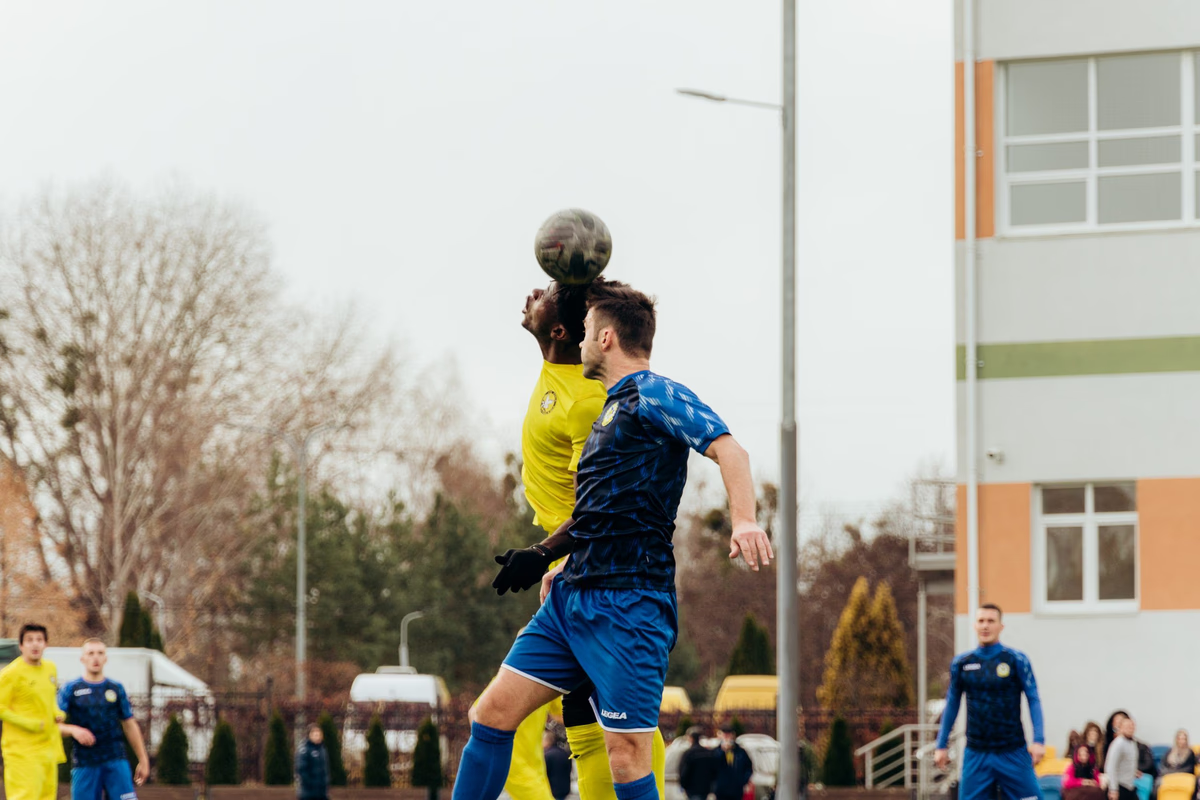
A defense that struggles with aerial deliveries, against a team whose entire system is built to attack the wings and cross.
That’s not a coincidence. It’s a door, waiting for someone to walk through.
The case for Senegal — cornered, but armed
Senegal lost 1-3 to France, but that score tells only half the story.
In the first half they were better than the scoreline — physically intense, disrupting France’s build-up, with Sadio Mané testing the keeper and creating big chances that went unconverted (The Guardian).
The collapse came after the break. When France moved Michael Olise central, Senegal lost their midfield shape, let the opposition slice through, and conceded twice late. The lesson was clear — Senegal couldn’t hold defensive concentration against sustained, lateral passing (The Guardian).
On personnel, Senegal are fully fit. The trouble is off the pitch.
There are reports of a dispute with the federation over unpaid coaching-staff wages, compounded by US visa rules that kept some support staff — including the team chef — from traveling, throwing their nutrition and prep into disarray (The Football Faithful).
Coach Pape Thiaw’s selection call is on the right wing. Ismaïla Sarr struggled against France, missing a close-range chance, and faces pressure from 18-year-old Ibrahim Mbaye — blistering pace, and a consolation goal against the French already to his name (Sports Mole).
There’s a tactical wrinkle in that finishing problem, too. Thiaw lamented after the France game that better efficiency should have had Senegal ahead at the break — they had the chances and squandered them. That’s the gap a desperate side closes when survival is on the line, and it’s why the right-wing call matters: Sarr’s experience against Mbaye’s raw threat could decide whether those first-half chances become goals this time.
The man to watch is still Sadio Mané.
Senegal’s 4-3-3 presses and counters hard, using Mané and the right winger to drag Norway’s full-backs out and open one-on-ones on the flanks. The midfield of Idrissa Gueye and Pape Gueye has one job — shut down Martin Ødegaard. Let Norway’s captain lift his head and thread it through, and Senegal’s line gets played in behind, over and over (Sports Mole).
The variables that swing it
This is the part the numbers can’t reach.
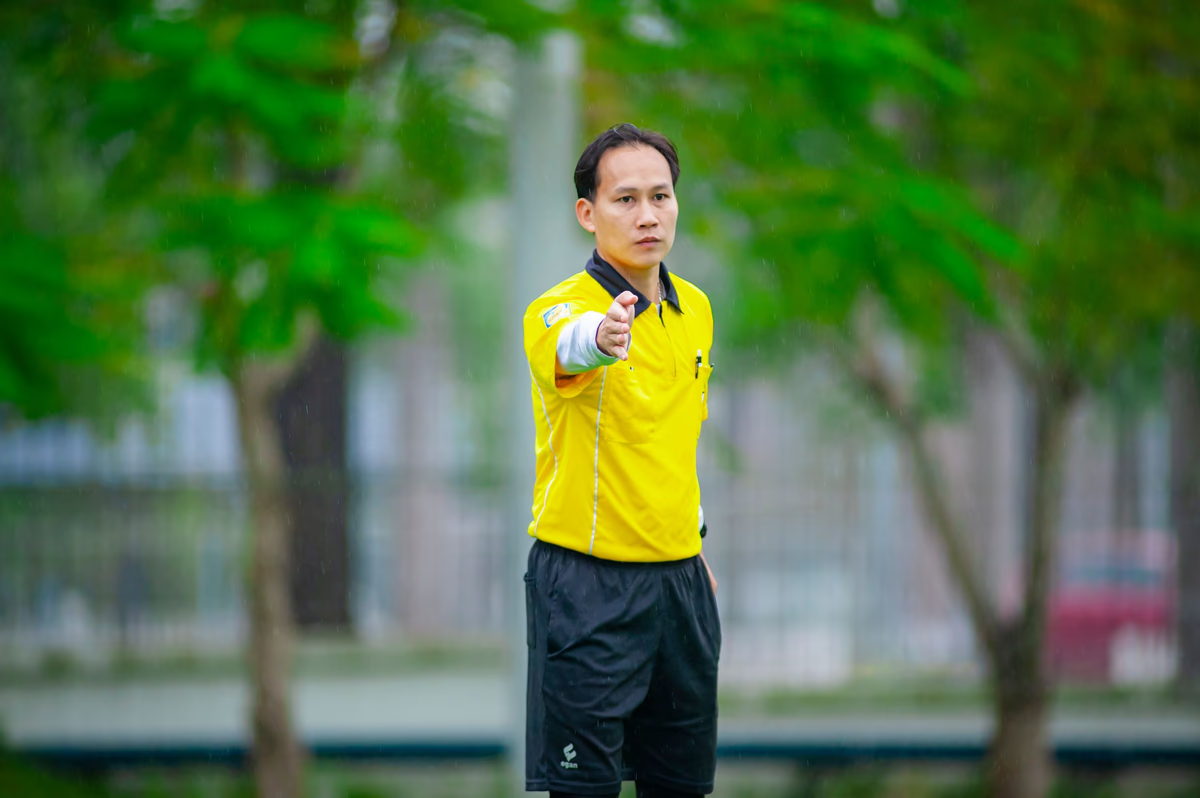
A card-happy referee. FIFA appointed Brazil’s Wilton Sampaio, and the name comes with a record every team must respect. He showed three straight red cards in the tournament’s opening match between Mexico and South Africa (India Today).
A 2026 rule change adds to the pressure: referees now use in-stadium microphones to broadcast VAR decisions to the whole crowd, raising the scrutiny on every call (Al Jazeera). For the full mechanics of these mics and the offside tech, see our guide to World Cup 2026 VAR and offside technology.
A game where Senegal’s seasoned defenders must physically battle Norway’s giant front line, refereed by a man this quick to reach for red, is a combustible mix.
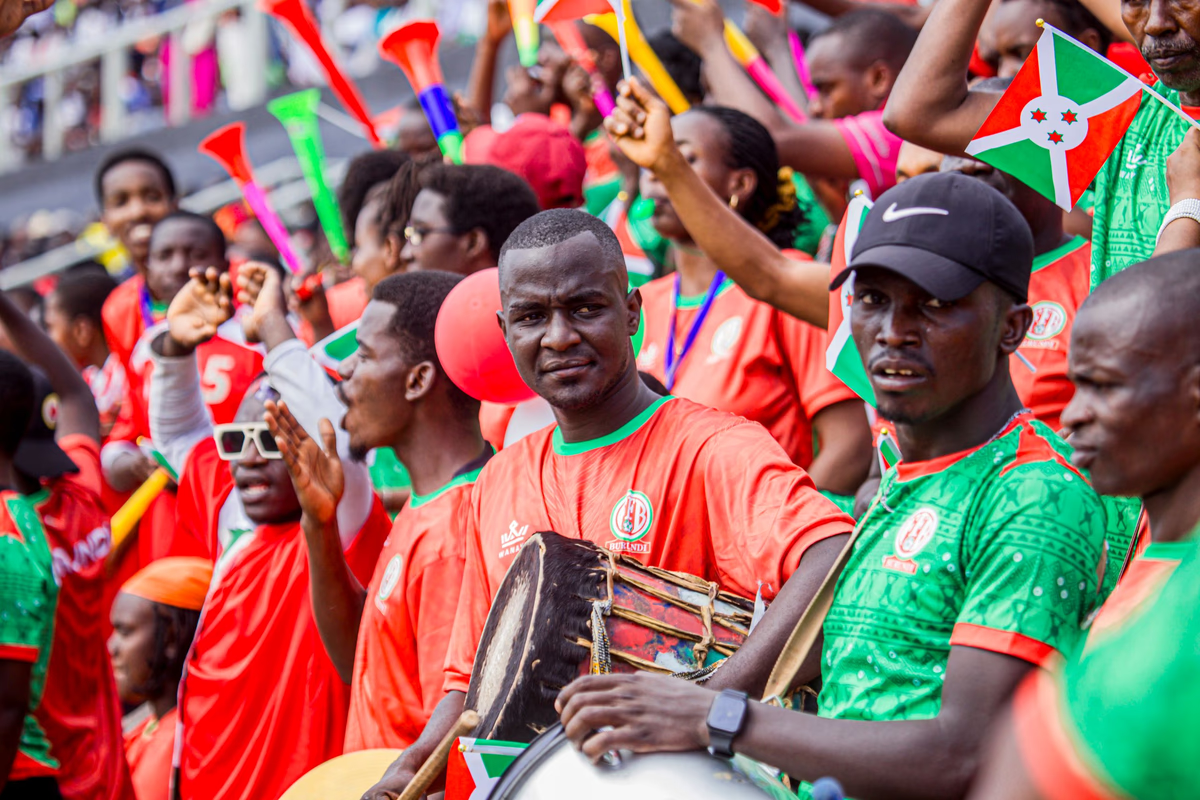
A neutral venue that won’t feel neutral. This is at MetLife Stadium in New Jersey — neutral on paper, but in reality a de facto home for Senegal. The New York–New Jersey area holds one of the largest Senegalese communities in North America, and while visa rules kept fans from Dakar from flying in, the local community has mobilized in force, with drums, chants, and African matchday rhythm (Vanguard).
Captain Kalidou Koulibaly spoke plainly about the visa policy that kept thousands of Africans away: “Every team can have their people, so I don’t understand why people from Africa cannot have their people… the most important is that we have to play for our people” (Vanguard). That sense of exclusion has hardened into a siege mentality in the dressing room.
History. This is the first competitive meeting between the two nations. The only prior link is a March 2006 friendly in Dakar, which Senegal won 2-1 against a Norway side built around John Arne Riise and Brede Hangeland (Sports Mole). Twenty years on, there’s no old grudge to carry — just fresh faces on both sides.
Where the number might miss
Run this game through a goals-only or xG model and you get a clear Norway edge — a 4-1 win against a side that just lost 1-3, the math has to favor Norway.
But that kind of model can’t price desperation.
It doesn’t know how differently a team plays when the match is a must-win versus a comfortable one. It can’t see the fire from the visa row, or hear the drums of a Senegalese community turning a neutral ground into a home.
And most of all, it can’t compute what happens when a cornered side’s do-or-die press collides with the quickest red card in the tournament.
A single hard challenge born of pressure could end in a dismissal — and rewrite the entire game in seconds.
That’s what a single number can’t tell you — and why reading a game means weighing both the number and the context, not one without the other.
So, how to read it
This game isn’t about who’s better on paper. It’s about who handles the pressure better.
If you trust Haaland’s form and Norway’s counter, already clicking from the opener — one path is clear.
If you trust that a cornered side, home-crowd drums, and a strict referee will crack the game open — the other path holds just as much weight.
Not a game decided on paper. Not an ordinary one. The kind where one side plays to advance and the other plays to survive — and where the team with nothing left to lose is often the most dangerous one on the pitch.
See every outcome’s probability and the latest number on the Norway vs Senegal match page, compare the whole group at the World Cup 2026 groups page, and browse every nation in the finals at the teams page.
Post-match update: Norway won 3-2 — see how well this pre-match read held up, and whether the factors we flagged actually mattered, in the Norway vs Senegal review.
Sources
- Norway vs Senegal — prediction, team news, lineups — Sports Mole, 2026
- Norway vs Senegal — match preview and team news — The Football Faithful, 2026
- Norway 4-1 Iraq — Haaland double on World Cup debut — The Guardian, 2026
- France 3-1 Senegal — match report — The Guardian, 2026
- Norway vs Senegal injury, suspension list, predicted XIs — Sports Mole, 2026
- Koulibaly questions US travel ban on African fans — Vanguard, 2026
- Who is Wilton Sampaio? Referee with three reds on Day 1 — India Today, 2026
- World Cup 2026 opening-day takeaways — reds, VAR, mics — Al Jazeera, 2026
- Norway vs Senegal — head-to-head record — Sports Mole, 2026
FAQ
- What time is Norway vs Senegal at World Cup 2026?
- The Group I Matchday 2 fixture kicks off at 20:00 ET on June 22, 2026 (00:00 UTC June 23, or 07:00 in Thailand) at MetLife Stadium in East Rutherford, New Jersey.
- Why does this match matter so much to Senegal?
- Senegal lost their opener 1-3 to France and sit on zero points. A second defeat would leave them needing best-third-place math that depends on other results and goal difference — effectively making this a knockout game. A Norway win, by contrast, takes them to six points and all but guarantees a Round of 32 spot.
- Does Norway have any injury problems?
- No injuries or suspensions. Full-backs David Møller Wolfe and Julian Ryerson had post-opener muscular fatigue but are cleared. The staff are expected to name an almost unchanged XI from the side that beat Iraq 4-1.
- Who is the referee, and why is that a variable?
- Brazil's Wilton Sampaio takes the game. He issued three red cards in the tournament's opening match (Mexico vs South Africa) and is a heavy user of the new in-stadium VAR microphone announcements. That strictness is a real risk in a match where Senegal's defenders must physically contain Norway's big front line.