Asia at the 2026 World Cup: 9 Nations, a New Era
Winning Score Team Published Tue 16 Jun Updated Tue 16 Jun
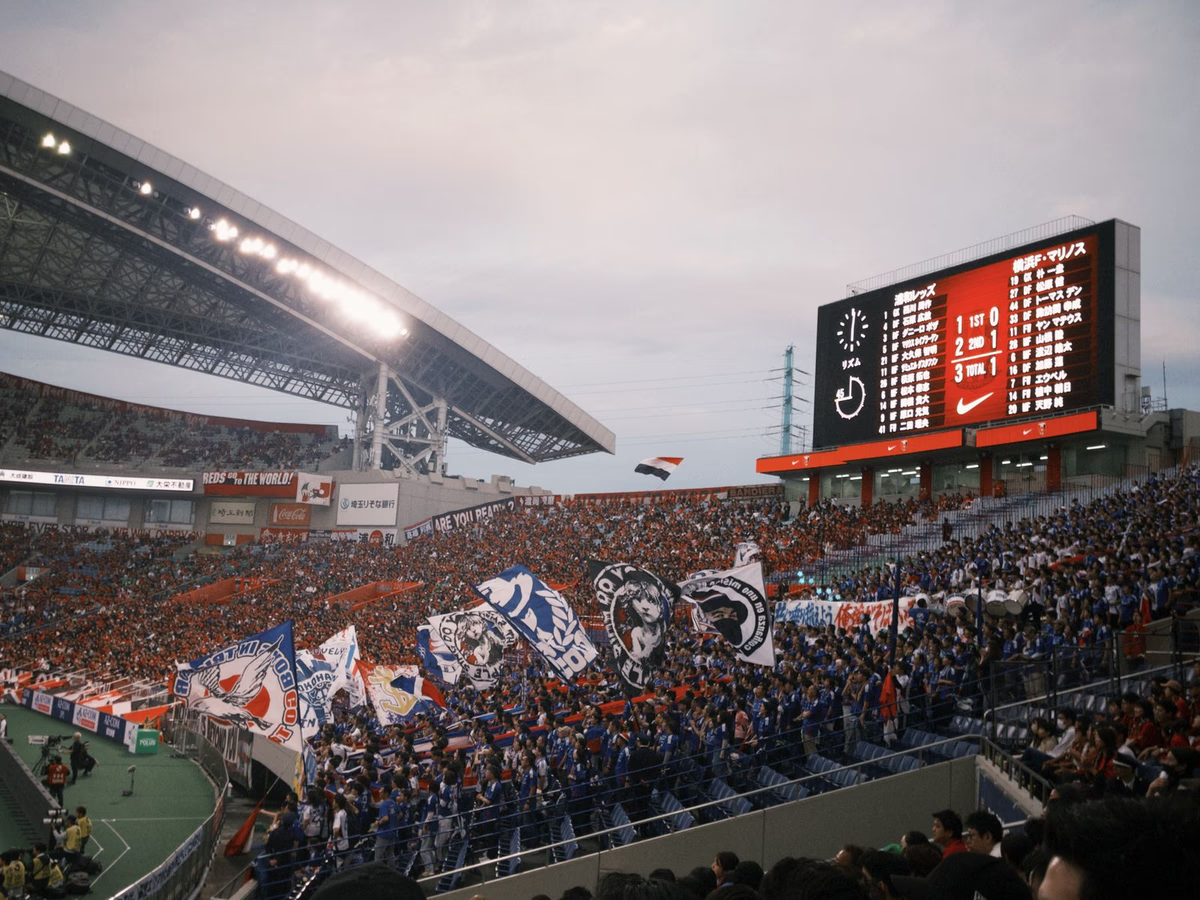
On 1 December 2022, Japan beat Spain — the 2010 world champions — while holding the ball for just 17.7% of the match.
The lowest possession figure for a winning team in recorded World Cup history (The Guardian/Opta).
That was not luck. It was not an accident.
It was the moment Asia stopped trying to play like Europe and mastered how to dismantle European football instead.
The short version (20 seconds)
- Asia sends a record nine nations to the 2026 World Cup — from the 8.5 slots of the 48-team era
- Asia’s automatic allocation nearly doubled, from 4.5 to 8.5 versus the 32-team era
- Milestones: South Korea’s 2002 semi-final, Japan beating Germany and Spain in 2022, three nations into the knockouts together in 2022
- Leading the group: Japan (18th), Iran (20th), South Korea (25th), Australia (27th)
- Thailand did not qualify — out in the second round on head-to-head behind China
- (Rankings and qualification as of June 2026)
The nine who reached North America
No previous World Cup has carried this many Asian teams.
| Nation | FIFA rank | Status |
|---|---|---|
| Japan | 18 | Direct (first nation to qualify, Mar 2025) |
| Iran | 20 | Direct |
| South Korea | 25 | Direct |
| Australia | 27 | Direct |
| Uzbekistan | 50 | Direct — first-ever debut |
| Qatar | 56 | Direct |
| Iraq | 57 | Via intercontinental playoff |
| Saudi Arabia | 61 | Direct |
| Jordan | 63 | Direct — first-ever debut |
(FIFA rankings as of June 2026 — FIFA)
Among them are Uzbekistan and Jordan, both reaching a World Cup for the first time in their history, and Iraq, ending a 40-year wait since 1986 by winning the intercontinental playoff on 31 March 2026.
The slots that nearly doubled
The number nine did not come from improved form alone. It came from a change to the structure of the tournament itself.
In the 32-team era (1998–2022) Asia held just 4.5 slots. When the World Cup expanded to 48 teams, the FIFA Council ratified an increase to 8.5 AFC slots on 9 May 2017 — eight direct places plus one to be contested in an intercontinental playoff (FIFA).
Nearly double.
This is the systemic shift that turns Asia from a “visitor” sneaking in a nation or two into a region whose new normal is almost ten representatives.
A climb made one step at a time
Asia did not get good overnight. This road took nearly 60 years.
It began in 1966 in England, where North Korea became the first Asian team to clear the group stage, beating Italy and reaching the quarter-finals before losing to Portugal.
But the biggest milestone came in 2002, when South Korea, as co-hosts, climbed to the semi-finals — the deepest run any Asian nation has ever managed. Along the way they knocked Italy out 2-1 on an Ahn Jung-hwan golden goal, then beat Spain 5-3 on penalties in the quarter-finals, before falling 1-0 to Germany (Wikipedia).
That side, under Guus Hiddink, changed the image of Asian football for good. Their fitness and discipline let them press European teams for a full 90 minutes, proving an Asian nation did not have to sit back and defend to compete with the giants. It became the template Japan and others would build on over the next two decades.
Then came 2022 in Qatar, where Japan stunned the world by beating both Germany and Spain 2-1 in the group stage. In the opener against Germany they trailed 0-1 before substitutes Ritsu Doan and Takuma Asano turned it around to win 2-1 in the second half — the same script they ran against Spain five days later: defend deep, wait, then strike fast. The win over Spain was a lesson in pure efficiency, not chance — 17.7% possession turned into the goals that mattered.

Between 2002 and 2022, Asian teams cleared the group stage seven times, peaking in 2022 when three nations reached the knockouts together.
| Year | Round of 16 | Beyond |
|---|---|---|
| 2002 | Japan | South Korea (semi-finals) |
| 2006 | Australia | — |
| 2010 | Japan, South Korea | — |
| 2014 | — | — |
| 2018 | Japan | — |
| 2022 | Australia, Japan, South Korea | — |
The graph does not rise every single year — in 2014 no Asian nation advanced at all — but the long-term trend is unmistakable, from one nation to three in two decades.
The teams to watch in 2026
The nine do not arrive with equal weight. Some come to make a statement; others to gain experience.
Japan (18th) under Hajime Moriyasu are the most fancied Asian side, and the first nation in the world to seal their ticket, back in March 2025, after a near-flawless qualifying campaign.
South Korea (25th) under Hong Myung-bo came through qualifying unbeaten — the only AFC nation to do so across the entire campaign.
Iran (20th) under Amir Ghalenoei sealed their place in March 2025 on the back of the resilient defending this team is known for. Australia (27th) under Tony Popovic chose a major overhaul, naming as many as 17 potential World Cup debutants.
Saudi Arabia (61st) arrive after coaching turbulence, most recently appointing Georgios Donis in April 2026.
But Saudi have left a mark the world remembers — in 2022 they produced one of the biggest shocks in World Cup history, beating eventual champions Argentina 2-1 in their opening game. Australia, too, reached the Round of 16 that year, beating Tunisia and Denmark in the group. Both results are proof that Asian teams today are not there to make up the numbers — they arrive with the ability to make the giants nervous from the first whistle.
The rest are a mix of old hands and new blood — Qatar (56th) return after hosting in 2022, Iraq (57th) end a 40-year wait, while Uzbekistan (50th) and Jordan (63rd) taste a World Cup for the first time. The story of both debutants is in the four nations making their World Cup debut.
A new format that suits Asia
There is one more factor that could change Asia’s path this year — the 48-team World Cup adds a new stage, the Round of 32.
Under the format FIFA approved on 14 March 2023, it is not only the top two from each group who advance, but the eight best third-placed teams as well (Wikipedia).
That means an Asian nation could clear the group stage with just one win, or a couple of strategic draws. The door that used to be narrow for second-tier teams is now far wider. The full mechanics are in the new 48-team World Cup format explained.
For fans in Thailand: where to watch, and a lesson to learn
Many Thai fans already follow Asian teams — Japan, South Korea and Saudi Arabia especially — even if there is no official survey data isolating Thai-market support for Asian sides at past World Cups.
On the viewing question, there is relief — the JAS (Jasmine) group secured the rights on 11 June 2026, showing all 104 matches on the Monomax platform, with over 40 key games including the opener and final going free-to-air on Monomax Sports (Bangkok Post).
But inside the joy of cheering for Asia is a lesson Thailand is still learning — the national team, ranked 94th, went out in the second round of Asian qualifying, level with China on points and goal difference (9 scored, 9 conceded) but eliminated on an inferior head-to-head. The gap between Thailand and Japan or South Korea is not about talent alone; it is the player-development systems those two nations laid down over decades.

From visitors to storytellers
When North Korea beat Italy in 1966, it was called a miracle. When Japan beat Germany and Spain in 2022, no one called it a miracle anymore — they called it a plan that worked.
That is the distance Asia has travelled — from a region happy just to be there, to one that arrives expecting to reach the knockouts.
But the road is not finished. Since South Korea in 2002, no Asian nation has reached the quarter-finals again. Asia has grown brilliant at toppling giants in the group stage, yet has never turned those wins into a deep knockout run. The challenge for 2026 is not just to clear the group — it is to break a ceiling that has stood for 24 years.
In 2026, with nine nations and a format that suits them, the question is simply how much further that road can go.
Follow every Asian nation and their rivals here:
- Check the rankings and form of every qualified nation on the teams page
- See all the groups at the group standings
- Read how the smaller nations are pushing through in the World Cup underdogs data story
Asia is not just there to take part anymore — it is there to tell a story.
Sources
- Teams qualified for the 2026 World Cup — AFC nations — FIFA, 2026
- FIFA Council ratifies 8.5 AFC slots for the 48-team era (May 2017) — FIFA, 2017
- Japan beat Spain 2-1 with just 17.7% possession — lowest for a winning team — The Guardian / Opta, 2022
- 2002 World Cup — South Korea reach the semi-finals — Wikipedia, 2026
- Monomax to broadcast all 2026 World Cup matches in Thailand (JAS deal) — Bangkok Post, 2026
- 2026 World Cup new format — Round of 32 — Wikipedia, 2026
FAQ
- How many Asian teams are at the 2026 World Cup?
- Nine AFC nations — Japan, Iran, South Korea, Australia, Uzbekistan, Qatar, Iraq, Saudi Arabia and Jordan — the most in history. They come from the 8.5 slots (8 direct plus 1 intercontinental playoff, won by Iraq) of the 48-team era (as of June 2026).
- What is Asia's best ever World Cup result?
- South Korea reached the semi-finals as co-hosts in 2002, the deepest run by any Asian nation. On the way they knocked out Italy and Spain before losing 1-0 to Germany.
- What did Asian teams achieve at the 2022 World Cup?
- Japan beat both Germany and Spain 2-1 in the group stage; the win over Spain came with just 17.7% possession, the lowest by a winning team in recorded World Cup history. Three Asian nations reached the knockouts together that year, a record.
- Did Thailand qualify for the 2026 World Cup?
- No. Thailand, ranked 94th by FIFA, were eliminated in the second round of Asian qualifying — level with China on points and goal difference (9 scored, 9 conceded) but out on an inferior head-to-head record (a 1-2 loss and a 1-1 draw).
- Where can you watch the 2026 World Cup in Thailand?
- The JAS (Jasmine) group secured the rights on 11 June 2026, showing all 104 matches on the Monomax platform, with over 40 key games including the opener and final simulcast free-to-air on Monomax Sports (as of June 2026).