Who Will Win the 2026 World Cup? The Data
Winning Score Team Published Tue 16 Jun Updated Tue 16 Jun
The biggest name on paper rarely lifts the World Cup.
Over the last seven tournaments, the side rated the number-one favourite before kickoff has won exactly once — Spain in 2010. Everyone else fell short, including Brazil, ranked world number one in 2022 and out by the quarter-finals.
So the real contenders are not measured by reputation or history. They are measured by squad depth, current form, and a body that survives the whole tournament.
The short version (20 seconds)
- FIFA ranking, June 2026: Argentina 1 · Spain 2 · France 3 · England 4 · Portugal 5 · Brazil 6
- Opta’s model makes France and Spain narrow co-favourites at ~15-17%, no team above ~17%
- Argentina and Brazil have the oldest squads (avg 28.6-28.7) in a tournament that demands 8 matches in 39 days
- Data-backed dark horses: Norway (Haaland) and Morocco (defence)
- (As of June 2026 — probability figures come from analytical models, not betting odds)
What the ranking says — and what it doesn’t
The final pre-tournament edition (11 June 2026) puts the defending champions on top, with the European pack right behind (FIFA).
| Team | World rank | Points |
|---|---|---|
| Argentina | 1 | 1877.27 |
| Spain | 2 | 1874.71 |
| France | 3 | 1870.70 |
| England | 4 | 1828.02 |
| Portugal | 5 | 1767.85 |
| Brazil | 6 | 1765.86 |
| Germany | 10 | 1735.77 |
Argentina has stayed in the top three through the entire cycle since winning Qatar 2022 — it slipped off the summit in mid-2025 before reclaiming first place in June 2026 on the back of warm-up wins over Iceland and Honduras.
But a ranking is a photograph of the past, not a forecast of the future. It captures accumulated form; it says nothing about who can survive this particular World Cup — and that is where the other numbers tell a different story.
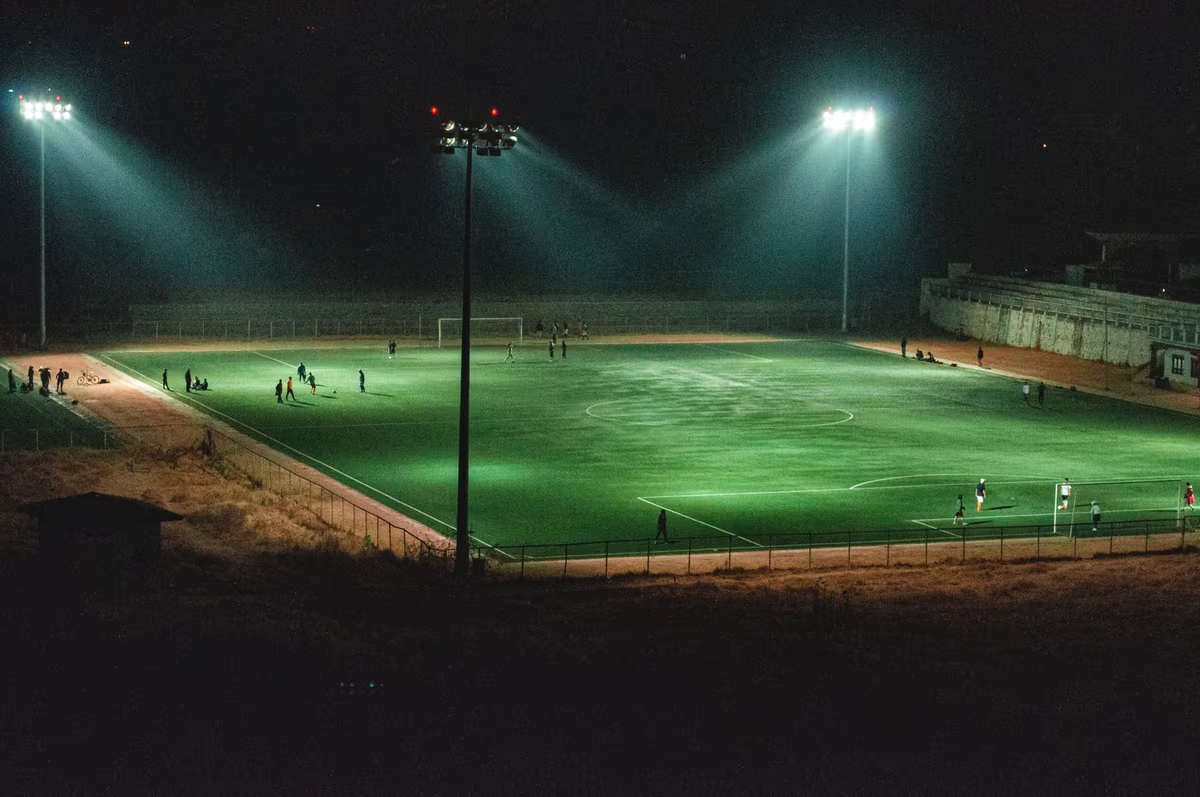
Real contenders are measured by depth, not names
The most important number this year may not be the ranking — it is average squad age.
Opta/FBref age data exposes a clear split between Europe and South America: the European nations have refreshed into their peak years, while the CONMEBOL heavyweights still lean on veterans (Business Standard).
| Nation | Avg squad age | Aged 30+ | Under 23 |
|---|---|---|---|
| Spain | 26.19 | 6 | 5 |
| France | 26.58 | 7 | 5 |
| England | 26.62 | 8 | 4 |
| Argentina | 28.62 | 9 | 2 |
| Brazil | 28.65 | 11 | 3 |
Why does this matter more in 2026 than ever before? The answer is the new format.
England’s peak-age numbers look healthy, but it carries a different risk — an overreliance on Harry Kane. In a 9 June 2026 analysis for The Guardian, Jacob Steinberg argues that if the 61-goal striker is shut down or injured, England has no proven alternative who replicates his all-round output (The Guardian).
Depth — not the starting eleven — is what this World Cup will test hardest.
The defending champion and the age question
Argentina arrive as world number one and reigning champions — yet the numbers flag their clearest risk.
Argentina’s squad averages 28.6 years, with nine players aged 30 or over and only two under 23. Brazil is older still — an average of 28.7, with eleven players over 30. The two South American giants carry the most veteran legs in the tournament, in an edition that demands eight matches, long travel and extreme heat.
Experience cuts both ways — it helps in high-pressure moments, but older legs recover more slowly across a congested calendar. European sides like Spain, younger and deeper, can rotate to stay fresh in the closing stages. That is exactly why several models do not make the defending champion their top pick, even with the world’s number-one ranking.
The 48-team format rewrites the math for everyone
A finalist this year must play eight matches in 39 days — up from the old seven-game standard. It is an unprecedented physical burden.
Analysis in the Aspetar Journal of Sports Medicine notes that high-intensity football depletes roughly 50% of muscle glycogen per match. With only three to four days of recovery in the group stage and four to five in the knockouts, teams without elite rotational depth face compounding fatigue, chronic inflammation, and a drop in focus deep into the tournament (Aspetar).
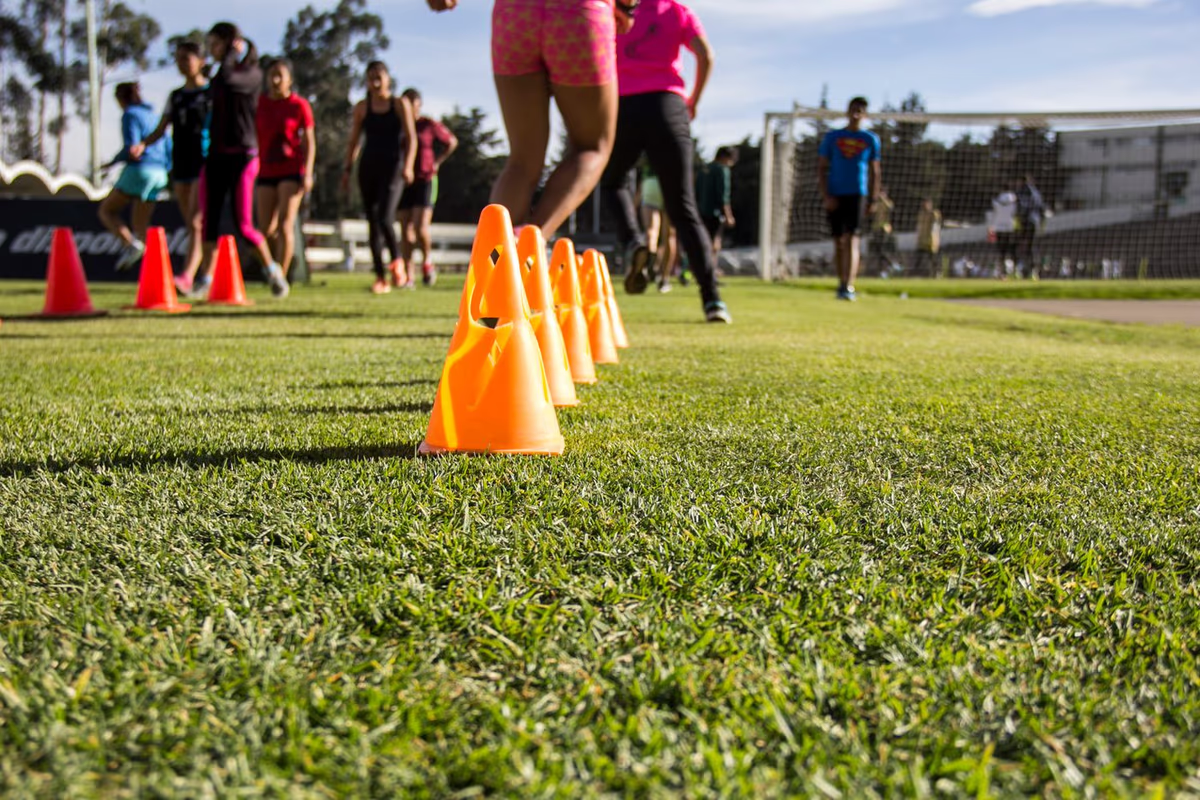
Then there are two factors unique to 2026 — heat and travel.
Some host cities, including Houston, Miami and Monterrey, produce a heat-stress index (WBGT) near 31°C, beyond the safe limit for athletes not acclimatised to it. FIFA has mandated three-minute hydration breaks midway through each half of every match. Meanwhile, teams crossing up to three time zones, on flights as long as seven hours, accumulate travel fatigue that disrupts sleep and recovery — so squads kept in a tight geographic pod gain an automatic edge.
And travel is not just a feeling. Analyses in the British Journal of Sports Medicine and by Aspetar — co-authored by FIFA Medical Commission representatives — find that crossing multiple time zones on long flights meaningfully disrupts sleep cycles and muscular recovery. Teams drawn into a tight regional pod gain a real physical edge, while those criss-crossing the continent between fixtures pay in fatigue that never shows up on the team sheet.
Heat, flights and eight games together favour young, deep squads over teams leaning on a handful of veteran legs.
Germany — the gap between name and ranking
If one team’s FIFA ranking misleads most, it is Germany.
Officially FIFA has them only 10th (1735.77 points), penalised for shaky friendlies and past tournament failures. Yet predictive models and editorial power rankings rate them far higher — Opta gives Germany around a 6% title chance (seventh overall), driven by an emerging golden generation built around Florian Wirtz and Jamal Musiala (Sports Illustrated).
Wirtz and Musiala are creative engines in their early twenties playing at Europe’s highest level every week — exactly the profile the eight-game, 39-day format rewards: technical quality on legs that stay fresh. Germany is the clearest case of why reading contenders off the ranking alone gets it wrong.
The ranking looks back; the model looks at the squad — and the two do not always agree.
Dark horses with the numbers to back it up
Beyond the giants, two names have clear statistical support — Norway and Morocco.
Norway pairs a peak-age squad (average 26.35) with the sharpness of Erling Haaland, who scored 16 goals in qualifying — a finishing point capable of breaching elite defences. Morocco (average 25.92) keeps the proven defensive system from its 2022 semi-final run, soaking up pressure from possession sides and countering with precision (Sports Illustrated).
A good dark horse does not have to reach the final — it just has to have a pattern that beats a giant on the night. And 48 teams make those nights more likely.
What the models say — and why they still miss
Opta’s supercomputer runs the tournament millions of times. The latest output makes France and Spain narrow co-favourites at around 15-17%, with Portugal, England and Argentina next.
These figures are a model projection, not betting odds — and the key thing to read is this: even the model’s top pick (around 17%) still has roughly an 83% chance of not winning. The 48-team format, with eight third-placed teams added to a Round of 32, only raises bracket variance and makes the winner harder to call (Lumivero).
History backs that caution. Across the last seven World Cups, the pre-tournament number-one favourite has won just once — about 14% of the time. Spain in 2010 is the only modern case where the top favourite actually delivered. The most painful counter-example is Brazil 2022: world number one, the pick of nearly every model, out in the quarter-finals on penalties to Croatia.
So why do the models keep missing? Look at what they train on — mostly league, qualifying and friendly matches, none of which carry the conditions of a 39-day, three-nation tournament in extreme heat with brutal travel. They overvalue pure technical talent and undervalue the durability of well-organised, supremely fit sides.
That is exactly how a team like Morocco 2022 runs further than every model predicted.
Read the contenders for yourself
The favourite on paper and the team that survives the whole tournament are not always the same. This year, watch three things together — ranking, squad depth, and the draw.
- Check the rankings and form of every nation on the teams page and compare deeper numbers on the stats page
- See who landed in a brutal section on the group standings and in this year’s group of death
- To understand why minnows topple giants more often now, read are minnows toppling giants? the data
Models give you numbers, rankings give you context — but nobody guarantees a champion before kickoff. And that is exactly why the World Cup is still worth waking up for.
Sources
- FIFA Men's World Ranking (latest edition, June 2026) — FIFA — FIFA, 2026
- 2026 World Cup Power Rankings — Spain, Argentina favorites; Norway dark horses — Sports Illustrated — Sports Illustrated, 2026
- World Cup 2026: youth versus experience (squad age) — Business Standard — Business Standard, 2026
- England's reliance on Harry Kane — Jacob Steinberg, The Guardian (9 Jun 2026) — The Guardian, 2026
- Nutrition for tournament soccer (8-match load, heat) — Aspetar Sports Medicine Journal — Aspetar Journal, 2026
- 2026 World Cup outcome probabilities from Monte Carlo simulation — Lumivero — Lumivero, 2026
FAQ
- Who is the favourite to win the 2026 World Cup?
- The June 2026 FIFA ranking has Argentina first, then Spain, France, England, Portugal and Brazil. Analytical models such as Opta make France and Spain narrow front-runners at around 15-17%, with no team above roughly 17% (as of June 2026, model projection, not betting odds).
- Why do pre-tournament favourites rarely win?
- Over the last seven World Cups, the top pre-tournament favourite has won just once (Spain 2010). The most recent example of a favourite falling is Brazil, ranked world number one in 2022, eliminated in the quarter-finals on penalties by Croatia.
- How much does squad age matter in 2026?
- More than ever, because finalists must play eight matches in 39 days. Argentina (average 28.6) and Brazil (28.7) have the oldest squads, while Spain (26.2), France and England sit in their peak years, giving the European sides a rotation advantage.
- Which dark horses have a data-backed case?
- Norway and Morocco. Norway pairs a peak-age squad (26.35) with Erling Haaland, who scored 16 goals in qualifying. Morocco (25.9) keeps the proven defensive structure from its 2022 semi-final run, soaking up pressure and countering.
- Does the 48-team format make the winner harder to predict?
- Much harder. Adding eight third-placed teams to a Round of 32 raises bracket variance. Monte Carlo modelling shows even the model's top pick (around 17%) still has roughly an 83% chance of not winning the tournament.