Curaçao: Smallest Nation in World Cup History
Winning Score Team Published Sun 14 Jun Updated Sun 14 Jun
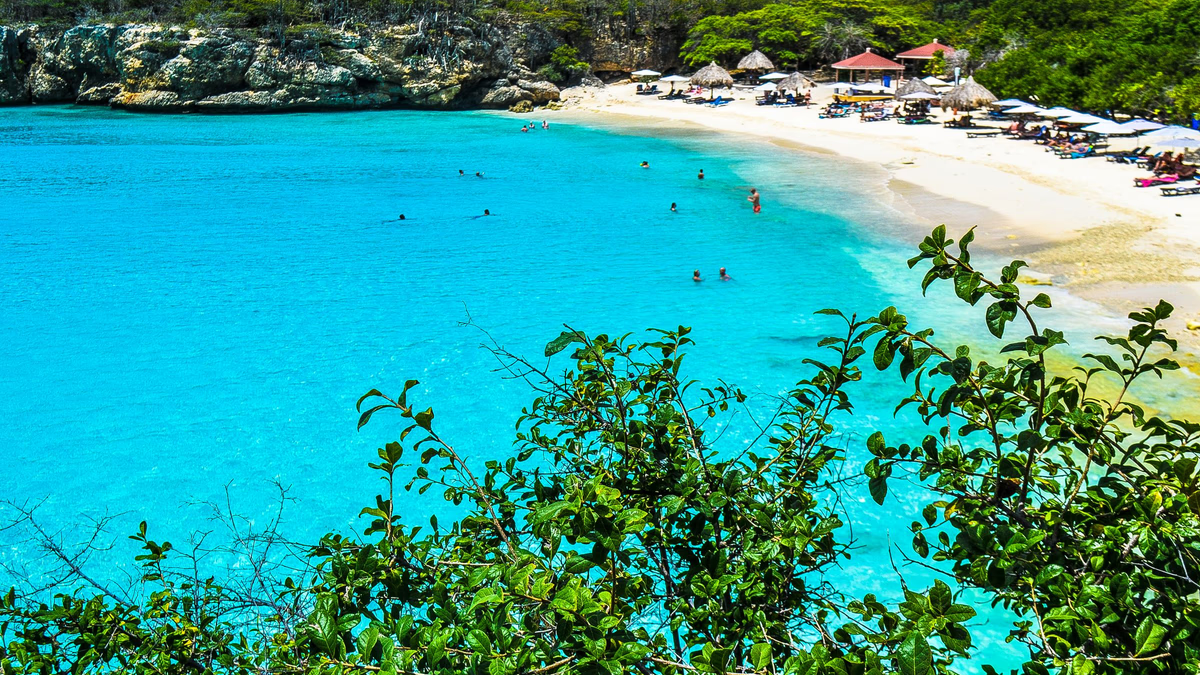
An island in the Caribbean. Fewer people than a mid-sized town. About to play at the World Cup.
Not by luck.
Curaçao — home to 156,000 people — just became the smallest nation in men’s World Cup history, breaking a record Iceland set when it stunned the world only a few years ago. And the part that defies expectation even more than the island’s size is how this team was built.
For the wider picture of why small nations keep closing the gap on the giants, read are minnows toppling giants more often — this piece is about Curaçao alone.
The 20-second version
- Smallest nation in World Cup history — roughly 156,000 people, past Iceland’s ~350,000
- Qualified on 18 Nov 2025 with a 0-0 draw at Jamaica — Group B winners, unbeaten in the final round
- Diaspora model: almost the entire squad was born in the Netherlands; only Tahith Chong was born on the island
- Head coach Dick Advocaat, 78 — the oldest coach in World Cup history
- Drawn in Group E with Germany, Ecuador and Ivory Coast; open against Germany on 14 June in Houston
The smallest nation the World Cup has ever seen
The number to remember is 156,000.
That was Curaçao’s population when the team qualified in November 2025, per the island’s Central Bureau of Statistics (CBS) — and as of 1 January 2026 it edged up to 158,006. Smaller than a typical mid-sized city.
Until now, the “smallest nation” record belonged to Iceland, which reached the 2018 World Cup with around 350,000 people. The world called that a miracle — but Curaçao has less than half of Iceland’s population, and is a fraction of the size of Trinidad and Tobago, which briefly held the record around 2006.
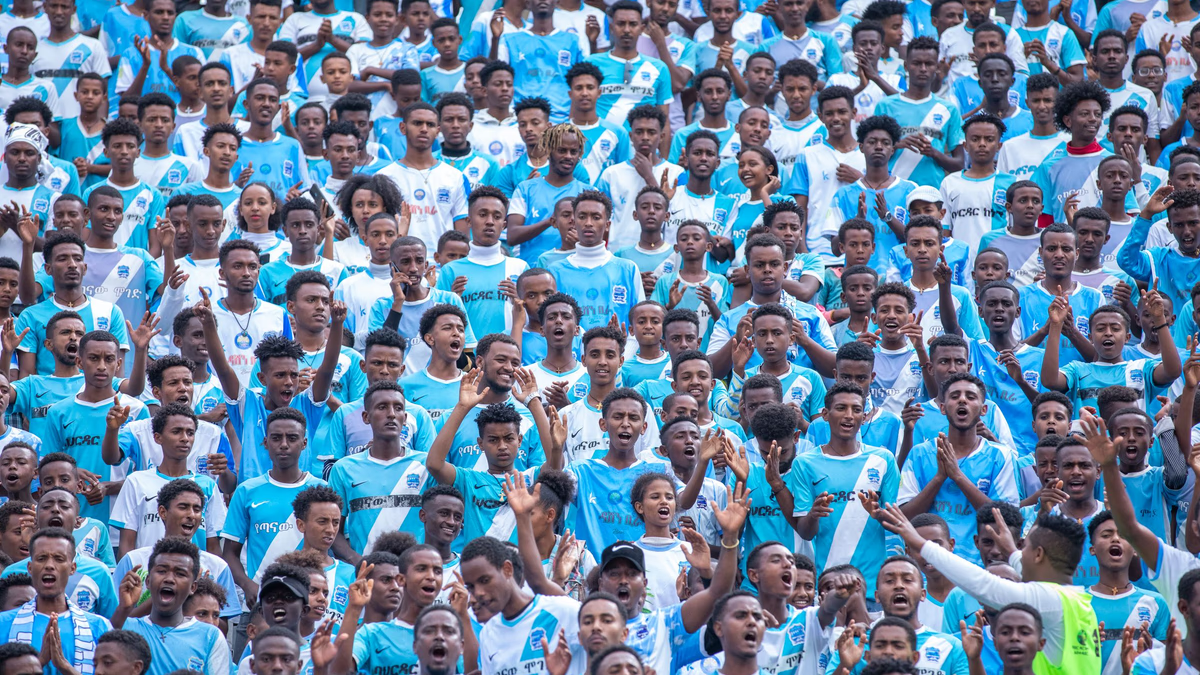
Major outlets worldwide confirmed the record together — CNN, The Guardian, AP and Fox Sports — all citing the same CBS figure. An island this size reaching a continental final round is not a one-off fluke. It is the product of a system built over many years.
Put it another way. The whole island holds fewer than 160,000 people — fewer than the combined attendance of two matches at a big stadium — yet it sent a team to share the stage with nations of hundreds of millions. That is a gap no number fully captures, and it is exactly why Curaçao’s story has gripped fans worldwide.
Why an island of 156,000 fields a team like this
The answer isn’t on the football pitches of the island — it’s in the Netherlands.
Curaçao is not the independent country many assume. It is a “constituent country” within the Kingdom of the Netherlands, the same status as Aruba and Sint Maarten. After the Netherlands Antilles was dissolved on 10 October 2010, Curaçao became its own FIFA member from 2011, inheriting the Antilles’ world ranking slot.
That membership in the Dutch Kingdom changed everything.
Many families of Curaçaoan heritage live in the Netherlands and put their children through Dutch football academies — the system that produces European-level players. Under FIFA’s eligibility rules (Articles 6 and 7), anyone with a Curaçaoan parent or grandparent can choose to play for Curaçao, even if they were born in Rotterdam or Amsterdam.
The result is a squad stacked with players from the Dutch and European leagues:
- Leandro Bacuna and Juninho Bacuna, two midfielder brothers with well over a hundred caps between them
- Tahith Chong, a winger at Sheffield United and a former Manchester United prospect
- Armando Obispo, a centre-back at PSV Eindhoven who switched his allegiance to Curaçao in September 2025
Obispo’s case tells the story best. He had come up through the Netherlands’ youth setup before using the one-time switch allowed under FIFA’s revised 2021 rule to commit to Curaçao instead. In other words, the Netherlands could in theory have kept these players in its own pipeline — but FIFA’s nationality rules let the opposite happen, and a small island got its sons back.
And here is the fact that sums up the whole story in one line — of the 26-man World Cup squad, only Tahith Chong was actually born on the island of Curaçao. Nearly everyone else was born in the Netherlands.
A team representing a Caribbean island, built almost entirely from the Dutch football pyramid.
The qualifying run — unbeaten into the finals
The diaspora model supplies the talent. But what actually took Curaçao to the World Cup were the results — and those were remarkably steady.
In the final round of CONCACAF qualifying, Curaçao were in Group B with Jamaica, Trinidad and Tobago, and Bermuda. Six matches, unbeaten throughout.
| Match | Result | Note |
|---|---|---|
| Trinidad & Tobago v Curaçao | 0–0 | A point on the road to start |
| Curaçao v Bermuda | 3–2 | A five-goal thriller |
| Curaçao v Jamaica | 2–0 | Move to the top |
| Curaçao v Trinidad & Tobago | 1–1 | Hold the lead |
| Bermuda v Curaçao | 0–7 | A statement win |
| Jamaica v Curaçao | 0–0 | Draw = qualified |
They finished the final round on 12 points (3 wins, 3 draws, 0 losses), a goal difference of +10, topping the group for a direct berth — no playoff needed.
The moment that settled everything came on 18 November 2025 at the National Stadium in Kingston, Jamaica. That 0-0 draw made Curaçao Group B winners and booked the first World Cup ticket in their history (CONCACAF official report). The whole island celebrated through the night — and there is a twist: Advocaat wasn’t even in the stadium that night, having flown back to the Netherlands on a family matter, yet the result still counts firmly as his campaign.

Curaçao now sit 82nd in the world on the FIFA chart (official, as of 11 June 2026) — a peak of 68th back in 2017, and a low of 183rd in 2014. A line that climbs from near the bottom to the top half tells the story of a team built over more than a decade.
A 78-year-old coach rewriting the record book
If the team is unusual, the coach is more so.
Dick Advocaat, a veteran Dutch manager who has led the Netherlands, South Korea and major European clubs across a 45-year career, took the Curaçao job in early 2024 and steered them to qualification.
The road to the tournament was full of drama — Advocaat resigned in February 2026 to care for his sick daughter; Fred Rutten stepped in and then resigned himself in May, before the Curaçao Football Federation brought Advocaat back on 13 May 2026.
That return (reported by Reuters) wrote history. At 78, Advocaat becomes the oldest head coach in World Cup history, surpassing Otto Rehhagel — who coached Greece at 71 in 2010 — by a full seven years. (As of June 2026; verify the coaching situation before relying on it.)
Group E and the fixtures to mark
The draw on 5 December 2025 in Washington, D.C. placed Curaçao in Group E with Germany (9th), Ecuador (24th) and Ivory Coast (42nd) — a group where they are the underdog on paper in every match.
Curaçao’s fixtures (US local context):
- Curaçao v Germany — 14 June 2026, NRG Stadium, Houston
- Ecuador v Curaçao — 20 June 2026, Arrowhead Stadium, Kansas City
- Curaçao v Ivory Coast — 25 June 2026, Lincoln Financial Field, Philadelphia
Under the 48-team format, each group has four teams; the top two advance directly, plus the eight best third-placed teams across all 12 groups, making 32 teams in the Round of 32 — so even a third-place finish can be enough. To understand the group mechanics in full, read how the 48-team World Cup format works.
Follow Group E’s live table and standings on the World Cup 2026 groups page, and browse every side at World Cup teams.
More than football — an island with its own identity
To understand Curaçao properly, you need one phrase: “Yu di Kòrsou” — “child of Curaçao,” spoken with deep pride on the island.
Curaçao has its own language, Papiamentu, a creole blending Portuguese, Spanish, Dutch, African languages and indigenous Arawak roots. Unlike many creoles, it is used at every level of society, not just at home. That is why a player born in Rotterdam can still feel a strong enough pull to wear the blue shirt of the island his family came from.
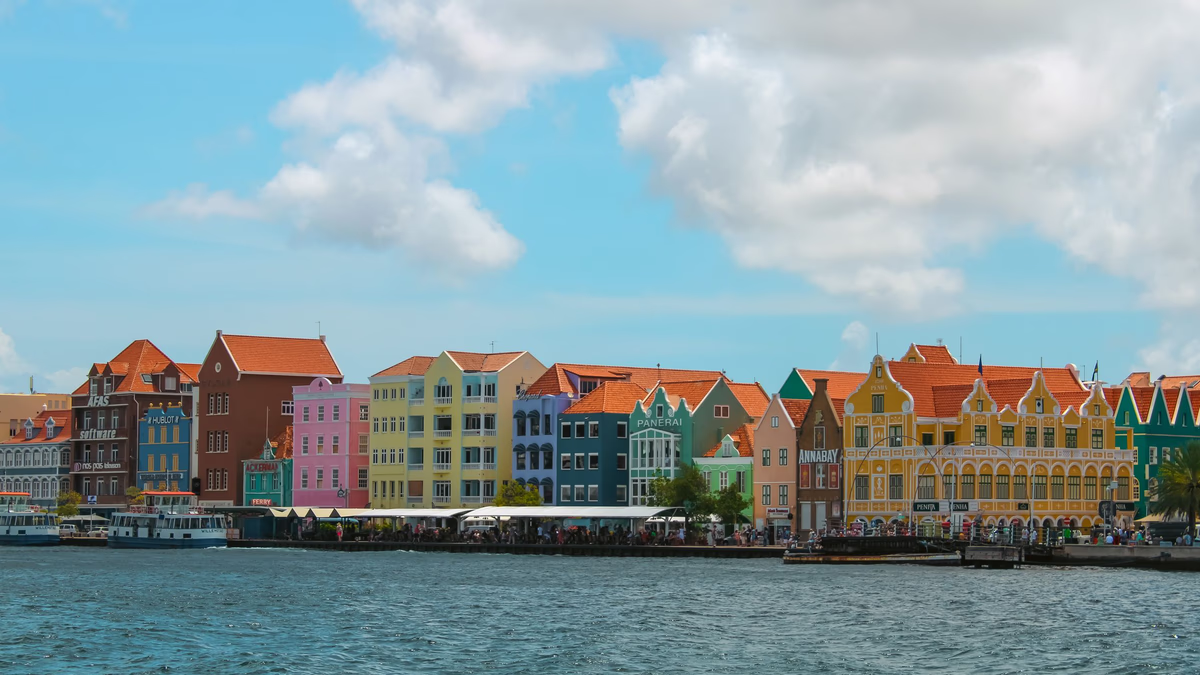
There is one more twist. At this World Cup, the Kingdom of the Netherlands will have two teams on the field — the Netherlands national side (one of the world’s top-ranked teams) and Curaçao. The Dutch outlet DutchNews.nl framed it plainly: “two countries from the Kingdom of the Netherlands will play in next year’s World Cup finals.”
The Netherlands itself missed the 2002 World Cup and has had to grind through European qualifying more than once. Meanwhile a small island tied to the same kingdom reached its first World Cup — with Dutch coaches, Dutch-trained players and a Dutch football philosophy. Two flags, one kingdom, on the same World Cup stage.
Underdogs on paper, history on the pitch
Curaçao won’t be favourites in Group E, and no one expects them to topple Germany.
But that misses the point.
The point is that an island of 156,000 people, with its own language, with players who chose to come back and play for their ancestors’ home, and a 78-year-old coach who refuses to hang up the whistle, is standing on the same stage as nations a thousand times its size.
The smallest nation in history didn’t get here on luck — it got here on a system built over many years.
To follow the story to the end, keep the World Cup 2026 groups page open and watch how far the Curaçao fairytale runs.
Sources
- Curaçao the smallest nation ever to qualify — CNN (18 Nov 2025) — CNN, 2025
- Curaçao complete fairytale with draw in Jamaica — The Guardian (19 Nov 2025) — The Guardian, 2025
- Population figures for Curaçao — Central Bureau of Statistics (CBS) — CBS Curaçao, 2026
- Curaçao secures historic World Cup berth — CONCACAF official — CONCACAF, 2025
- Advocaat returns, set to become oldest coach in WC history — Reuters (12 May 2026) — Reuters, 2026
- Curaçao FIFA ranking (official) — Inside FIFA — FIFA, 2026
- Two countries from the Kingdom of the Netherlands at one World Cup — DutchNews.nl (18 Nov 2025) — DutchNews.nl, 2025
- Curaçao Group E fixtures, World Cup 2026 — kickoffclock — kickoffclock, 2026
FAQ
- Is Curaçao really the smallest nation ever to qualify for a World Cup?
- Yes. With roughly 156,000 people at the time of qualification in November 2025 (per Curaçao's CBS), it overtook Iceland (around 350,000 in 2018) as the least-populous nation in men's World Cup history — confirmed by CNN, The Guardian, AP and Fox Sports.
- How does such a tiny island field a World Cup team?
- Because Curaçao is a constituent country within the Kingdom of the Netherlands. Many players of Curaçaoan heritage are born and developed in the Dutch football system and can choose Curaçao under FIFA's eligibility rules (Articles 6–7). Of the 26-man World Cup squad, only Tahith Chong was actually born on the island.
- Which group is Curaçao in at World Cup 2026?
- Group E, alongside Germany, Ecuador and Ivory Coast. They open against Germany on 14 June 2026 in Houston. Curaçao's official FIFA ranking sits at 82nd in the world (as of 11 June 2026).
- Who is Curaçao's head coach at World Cup 2026?
- Dutch veteran Dick Advocaat, 78, reappointed on 13 May 2026. That makes him the oldest head coach in World Cup history, surpassing Otto Rehhagel (71, Greece 2010). Verify the coaching situation before relying on it, as of June 2026.